
A 4-point inspection form is the insurance-underwriting report Florida carriers use on older homes, covering the roof, electrical, plumbing and HVAC. The right form is whichever one the homeowner's carrier asks for. For a roofing company, the roof section is the page that matters, because its remaining-useful-life finding can decide whether a policy gets written.
Picture a homeowner in a 1990s subdivision in Mandarin, still on the original shingle roof, applying for a new policy this fall. The agent asks for a 4-point. The inspector goes up, looks at the shingles, and has to document how many years the roof has left. If that number comes back short, the homeowner needs a re-roof before the policy is written, and the carrier's paperwork sets the deadline.
That homeowner has not filled out a lead form. No roofer has been called yet. Knowing what the form asks, and which homes are about to face it, gets your crew to the door before the report lands.
What does a 4-point inspection consist of?
A 4-point inspection is a check of four systems by a Florida-licensed inspector: the electrical system, plumbing, heating and cooling, and the roof. Each system gets its own section on the form.
Three of those four belong to other trades. The roof section is yours. It is where the roof's remaining useful life gets documented, and on an older roof that one line can decide whether the policy is written.
What are the requirements for a 4-point inspection in Florida?
The requirement comes from the insurer, and Citizens Property Insurance requires a four-point inspection for all property owner, dwelling and mobile home applications on properties more than 20 years old.
In 2026, that 20-year line falls in the mid-2000s.
Citizens then adds a roof rule on top. Roofs past certain ages need documentation of at least five years of remaining useful life, and when a roof has less than five years left, the owner must provide proof of a full-roof replacement before any policy is written.
| Roof | When Citizens asks for proof | What the report has to show |
|---|---|---|
| Soft (shingle or similar) | Older than 25 years | At least five years of remaining useful life |
| Hard | Older than 50 years | At least five years of remaining useful life |
| Any roof the inspection finds short | Under five years of life left | Proof of a full-roof replacement before a policy is written |
State law sits underneath the carrier's rules. Under Fla. Stat. 627.7011, for a roof at least 15 years old, the insurer must allow the homeowner to have the roof inspected by an authorized inspector, at the homeowner's expense, before requiring replacement. The insurer also may not refuse to issue or renew a policy solely because of roof age if that inspection shows 5 or more years of useful life remaining. The non-renewal side of that statute has its own post on this blog. Here, the point is that the five-year number shows up in both places, and the roof section is where it gets decided.
Other carriers set their own thresholds. Don't quote Citizens' numbers to a homeowner insured somewhere else; send them to their agent.
Where can I find a free 4-point inspection form PDF?
The right free form is the one the homeowner's own carrier asks for, so the homeowner or their agent should get it from that carrier instead of a generic template download.
Generic home inspection templates are easy to find, and some of them look official. A 4-point report goes to an underwriter, though, so the carrier's version is the one that avoids a second round of paperwork. For your sales team, the whole topic becomes one plain script line: "Ask your agent which 4-point form your carrier uses. I can give you an honest read on the roof before the inspector gets there."
What will fail a 4-point inspection in Florida?
On the roof side, the finding that stops a Citizens policy is a roof with less than five years of remaining useful life, because Citizens then requires proof of a full-roof replacement before any policy is written.
Electrical, plumbing and HVAC findings follow each carrier's own standards, and those are for the agent and the inspector to explain. Your job is the roof. Stay out of interpreting the policy; that ground belongs to the agent.
The roof arithmetic is simple. A house built in 2000 that still has its first shingle roof is 26 years into that roof, past Citizens' 25-year line for soft roofs. When you inspect one of those, give the honest read. If the roof has years left, say so. A homeowner who hears "you have time" from a roofer remembers that roofer when the time runs out. If it has less than five years, you are the contractor already in the driveway with a replacement proposal.
Can you get insurance without a 4-point inspection in Florida?
Not from Citizens on an older home, because Citizens requires a four-point inspection for all property owner, dwelling and mobile home applications on properties more than 20 years old. Other carriers write their own rules, and the homeowner's agent is the one to ask.
That narrow fact is the one that helps you prospect. Every home past 20 years that applies with Citizens produces a 4-point report, and every soft roof past 25 years on that report has to show five more years of life.
How should a roofing company use the 4-point form to find re-roof jobs?
Use the form's thresholds as a timing map: homes past 20 years that still carry a shingle roof older than 25 are the ones most likely to need roof documentation at their next Citizens application.
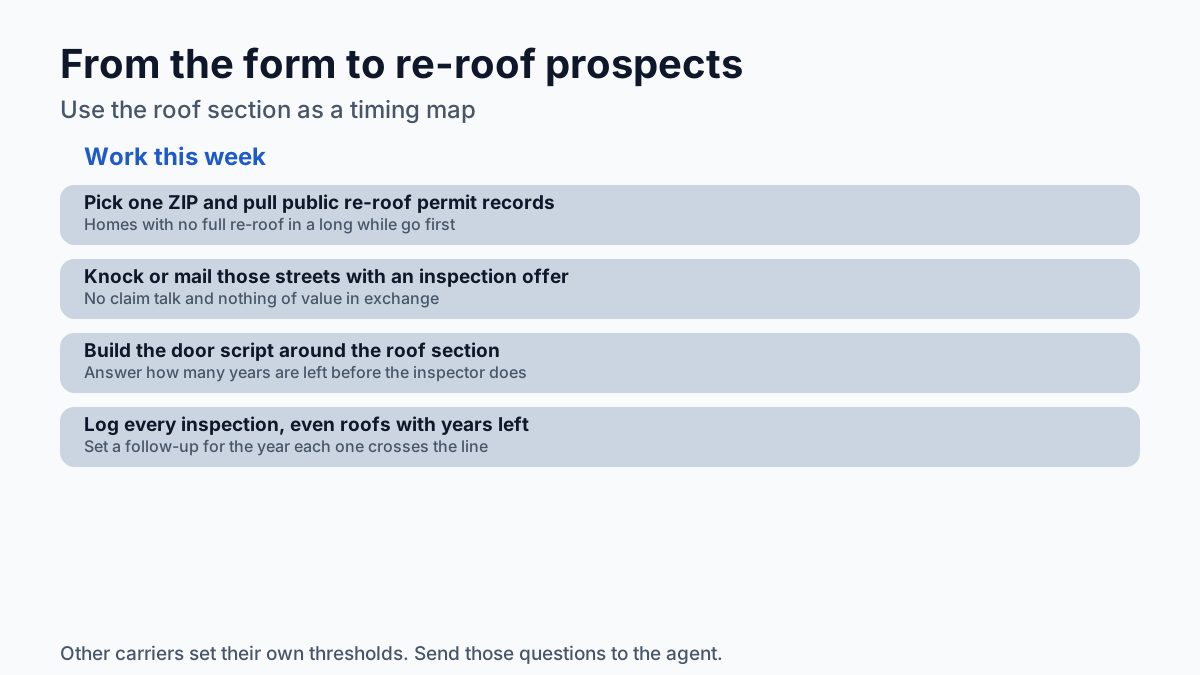
Here is what that looks like as work for this week:
- Pick one ZIP and pull the public building permit records for re-roof permits. Homes with no full re-roof permit in the last 25 years go to the top of the list.
- Knock or mail those streets first, with a straight offer of a roof inspection. No claim talk, and nothing of value in exchange for the inspection.
- Build the door script around the form: the roof section asks how many years the roof has left, and you can answer that before the inspector does.
- Log every inspection, including the roofs with years left, and set a follow-up for the year each one crosses the line.
Doing the permit pull by hand works, but it is slow, and nothing stops the roofer down the road from working the same streets. Roof Identifier ranks Duval County homes by how likely the roof is due and keeps each ZIP to one roofer through Territory Lock, so if you want to see it on your own streets, ask for a free ZIP Roof Report for your ZIP, or check whether your ZIP is still open.
Frequently asked questions
Which 4-point inspection form should a homeowner use?
The one their own carrier asks for, so the homeowner or their agent should get that version from the carrier instead of a generic download.
Who performs a 4-point inspection for a Citizens application?
A Florida-licensed inspector checks the home's electrical system, plumbing, heating and cooling (HVAC) and roof.
At what roof age does Citizens ask for proof of remaining useful life?
Citizens asks for documentation of at least five years of remaining useful life on soft roofs, such as shingle, older than 25 years and on hard roofs older than 50 years. If the roof has less than five years left, the owner must show proof of a full-roof replacement before any policy is written.
Can an insurer refuse to renew a policy only because the roof is 15 years old?
Under Fla. Stat. 627.7011, the insurer must allow an inspection by an authorized inspector, at the homeowner's expense, before requiring replacement of a roof at least 15 years old. It may not refuse to issue or renew solely because of roof age if that inspection shows 5 or more years of useful life remaining.