
Architectural shingles are laminated asphalt shingles, also sold as dimensional shingles, made from two or more bonded layers so the finished roof shows depth and shadow lines instead of the flat, even slots of a three-tab. On the wrapper, the numbers a sales rep needs to know are the wind classifications: ASTM D3161 Class F and ASTM D7158 Class H.
That is most of what a homeowner at the kitchen table wants explained. The weak version of the pitch says "architectural" as if the word sold the job by itself, then stalls when the homeowner asks what the wind rating means or why this quote is higher than the one from the company down the road. This post is for the owner or sales manager who wants every rep able to answer those questions in plain words, without promising anything the product sheet does not back.
What are architectural shingles, and how do they differ from three-tab?
Architectural shingles are the laminated, multi-layer form of the asphalt shingle, while a three-tab is a single flat layer cut into evenly spaced tabs. The added layer gives the roof its texture and makes the shingle thicker.
Your crews already know that. The sales question is how the homeowner hears it. To most people at the door, "architectural" sounds like a premium upgrade or a style choice. In many quotes it is simply the asphalt line the company installs as its standard, with premium and impact-rated lines priced above it. The full good-better-best ladder inside the asphalt family, including Class 3 and Class 4 impact ratings, belongs to our companion post on the shingle roof as the default Duval re-roof. Here the focus is narrower: what the architectural label covers, and what a rep can point to.
The first thing to point to is that the product has a written standard behind it. ASTM D3462 is the specification for asphalt shingles, and it includes prescriptive mass requirements for the shingles and many of their individual components. Get the number right on your quote sheets and in your scripts: D3462 is the product spec, and a rep who rattles off the wrong standard to an engineer-minded homeowner in Mandarin or Ponte Vedra Beach loses credibility he will not win back on that visit.
That gives a rep an honest answer when a homeowner asks whether all shingles are the same. They are not, and the difference is written down. A homeowner who has been told otherwise by a lower bidder can be shown that the category has a published specification with mass requirements, and that your quote names the exact product line so they can check it.
How can you tell if you have architectural shingles?
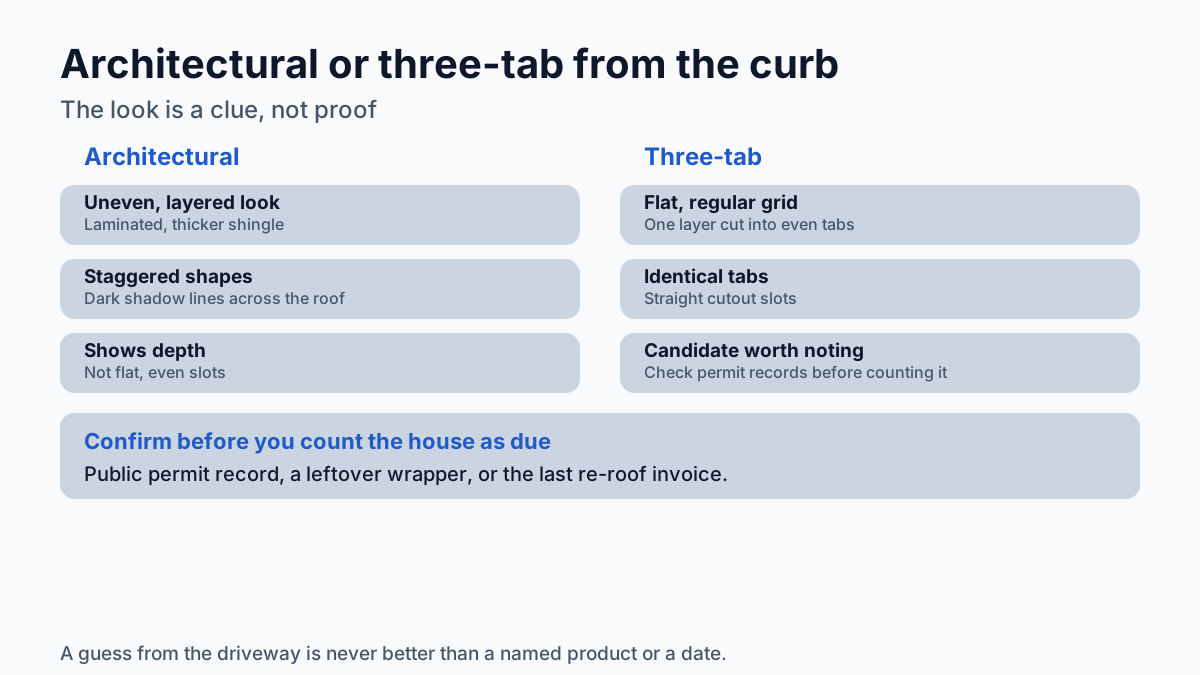
You can usually tell architectural shingles from the street by their uneven, layered look: staggered shapes and dark shadow lines across the roof, where a three-tab roof shows a flat, regular grid of identical tabs and straight cutout slots.
For a canvasser, that difference is a sorting tool. Picture a two-person team working a 1990s subdivision off a main road on the Southside. A roof that still shows the flat grid of a three-tab is a candidate worth noting. A roof that shows layered shadow lines may have been replaced at some point, or may have been built that way. Either way, the look from the sidewalk is a clue and not proof, so the careful move is to check the address against public building-permit records before you count the house as due.
At the door, the homeowner may ask you the same question about their own roof. The useful answers are concrete: a leftover bundle wrapper in the garage, the invoice from the last re-roof, or the permit record for the address. Each one names a product or a date, and either is better than a guess from the driveway.
What do Class F and Class H mean on a shingle wrapper?
Class F and Class H are the top wind ratings in the two ASTM test methods printed on asphalt shingle wrappers: Class F is the highest result in the D3161 fan-induced test, and Class H is the highest in the D7158 uplift test.
The Asphalt Roofing Manufacturers Association's standards page states it without hedging. For D3161, "in this test, Class F is the highest (best) rating," and the fan-induced test is conducted for two hours. For D7158, the same summary of the uplift test says "in this test, Class H represents the highest (best) wind resistance level."
| Test method | How it tests | Top class |
|---|---|---|
| ASTM D3161 | Fan-induced wind, run for two hours | Class F |
| ASTM D7158 | Uplift force on the shingle | Class H |
NRCA's Professional Roofing magazine translates the classes into wind speeds. It lists D3161 Class A, D and F at 60, 90 and 110 mph, and D7158 Class D, G and H at basic wind speeds of 115, 150 and 190 mph. Those figures help a rep explain the ladder, but they come from two different methods, so a rep should never tell a homeowner that 190 "beats" 110 as if both sat on one scale. The honest line is simpler: each class is the top class in its own test.
Here is a script line that stays inside the facts:
This shingle is labeled Class F under ASTM D3161 and Class H under ASTM D7158. Those are the top classes in both of the standard wind tests. I can show you both on the wrapper.
That line names a product fact, offers proof, and stops. It does not say the roof will survive a particular storm, and it does not touch insurance. Premiums and claims are outside what a wrapper can tell anyone, so they stay out of the pitch.
How does the wind rating change a re-roof conversation in Northeast Florida?
The wind rating gives a rep something specific and checkable to say about a roof that takes summer thunderstorms and fall nor'easters, without making a promise about any storm or any insurer.
Wind is often the first thing a homeowner in this market raises. A house a few blocks back from the ocean in Atlantic Beach or Neptune Beach sits in onshore wind and salt air most of the year. Farther inland, west toward Baldwin or south toward Orange Park, the worry may be oak limbs and debris in a squall. Different streets, same question: will these shingles stay on?
A good rep does not answer with adjectives. He answers with the classification on the wrapper and the installation the crew will do, and then he lets the homeowner compare. A lower bid that does not name its product line, or names a line without a printed wind class, is now something the homeowner can ask the other company about. You did not run anyone down. You gave the homeowner a better question.
That is also how you keep the wind conversation lawful and calm. Skip the hurricane talk and the fear. State the class, show the wrapper, write the product name on the contract.
What roof shingles to stay away from?
The shingles to steer a customer away from are any product a rep cannot name on the quote and back with a printed wind classification, because an unnamed or undocumented shingle leaves the homeowner nothing to verify.
This is not a knock on any category of asphalt shingle. Three-tab, architectural and premium lines all have a place, and a reputable company can install any of them well. The risk is in the paperwork. A quote that says "architectural shingles, color of choice" and nothing else invites the homeowner to treat your bid as interchangeable with the cheapest one on the counter.
So the rule for your reps is the reverse of the homeowner's question. Never quote a shingle you cannot identify by manufacturer and line, and never quote a wind class you cannot show on the wrapper or the product literature. If a homeowner asks which shingles to avoid, the answer that builds trust is "any shingle the contractor will not name in writing," followed by the name of yours.
How should a rep answer a homeowner who says the roof quote is too high?
A rep should answer a too-high objection by walking the homeowner through what the quote covers (the roof's size and pitch, the tear-off, decking repairs, flashing, ventilation and the shingle line) instead of defending the total.
Homeowners ask this one because a single number with nothing under it feels arbitrary. The rep's job is to make the number legible. Put the quote and the competing quote side by side and compare the parts. Is it the same shingle line and the same wind class? Does the lower number include the tear-off, or is it a lay-over? Does it include replacing soft decking, or does it treat that as an unpriced surprise? Are permit and disposal in the price?
A two-story house on a lot in Riverside with steep sections and old decking is a different job from a single-story ranch in Arlington, even if both homeowners say "I need a new roof." Once the line items are on the table, the homeowner is no longer comparing your total with someone else's total. They are comparing what each company will do, which is a comparison a well-run company wins on its own terms.
How long is a roofer liable for his work?
How long a roofing company stays responsible for its work depends on the written warranty it gives and on Florida law, and the legal limits are a question for your attorney, not something a rep should state at the kitchen table.
What your company controls is the warranty document. Spell out the workmanship term in writing, keep it separate from the manufacturer's material warranty, and list what each one covers. Manufacturer warranty terms on architectural shingles vary by product line, and the long-label warranties that show up in premium quotes are their own subject; our companion post on 50-year shingles covers what those labels mean and how to word them without overselling.
The practical point for the sales side is consistency. If two reps describe the workmanship warranty two different ways, the homeowner remembers the more generous version. Give every rep the same one-paragraph description, word for word, and make sure it matches the contract.
Do roofers have to give a guarantee?
Whether a written guarantee is legally required is a question for your attorney, but homeowners comparing bids ask for one, and a written workmanship warranty with a stated term and clear exclusions is the version that holds up in a sales conversation.
A verbal "we stand behind our work" does nothing when the homeowner is holding another company's warranty sheet. A printed page does. It also protects the company: a warranty that states its term and its exclusions in writing is easier to honor fairly than a promise each rep remembers differently.
Can a roofer sue me if he falls off my roof?
The homeowner asking this wants to know whether your company carries its own insurance for its crews, and the answer that settles it is a current certificate of insurance handed over before the contract is signed, with any legal question sent to an attorney.
Put the certificate in the standard proposal packet so the rep never has to improvise an answer about liability. The homeowner gets a document they can read, and the rep stays out of giving legal opinions, which is where he belongs.
How do you find more homes ready for a re-roof?
The steadiest way to find homes ready for a re-roof is to work the streets where roofs are likely due, using visible clues like a flat three-tab grid and public permit records, instead of knocking or mailing an entire ZIP.
Mailing a whole ZIP spends money on houses re-roofed three years ago. Knocking a whole ZIP spends a Saturday on them. The architectural-versus-three-tab look from the sidewalk helps narrow a route, and permit history narrows it further, but doing that street by street across Duval County is slow work for a sales manager who also has crews to schedule.
Roof Identifier does that sorting for Duval County roofing companies: it ranks homes by how likely the roof is due for replacement, and Territory Lock holds a ZIP for one roofer at a time, so the homeowners on your list are not being worked off the same list by another company. If you want to see how that looks on your own streets, ask for a free ZIP Roof Report for your ZIP, or check whether your ZIP is still open.
Frequently asked questions
Are architectural shingles the same as dimensional or laminated shingles?
Yes. Architectural, dimensional and laminated are names for the same multi-layer asphalt shingle, built from bonded layers that give the roof depth and shadow lines, unlike the single flat layer of a three-tab.
What is the warranty on architectural shingles?
Manufacturer warranty terms on architectural shingles vary by product line, so a rep should quote the exact line and its printed terms. Keep that material warranty separate from your company's written workmanship warranty, and describe both the same way on every quote.
Which ASTM standard is the asphalt shingle product specification?
ASTM D3462 is the product specification for asphalt shingles, and it includes prescriptive mass requirements for the shingles and many of their components. The wind ratings come from separate test methods, ASTM D3161 and ASTM D7158.
Can a rep compare a Class F rating directly with a Class H rating?
No. Class F comes from the D3161 fan-induced test, which runs for two hours, and Class H from the D7158 uplift test, so the two sit on different scales. The honest line is that each is the top class in its own test.
Sources reviewed
- Asphalt Roofing Manufacturers Association: Asphalt Shingle Product and Test Standards
- Asphalt Roofing Manufacturers Association: Asphalt Shingle Product and Test Standards
- Asphalt Roofing Manufacturers Association: Asphalt Shingle Product and Test Standards
- Asphalt Roofing Manufacturers Association: Asphalt Shingle Product and Test Standards
- Professional Roofing (NRCA): Understanding asphalt shingle standards