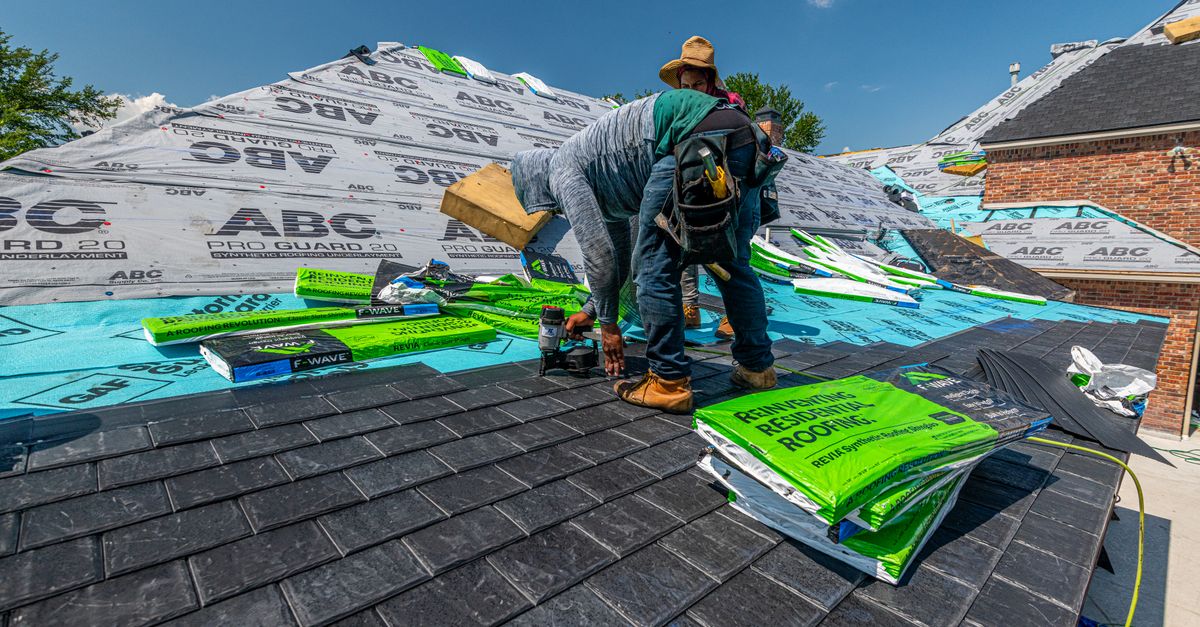
A new roof costs whatever that house's size, pitch, material, layers to tear off and decking condition add up to, so no honest single price exists until someone measures the roof. For a roofing company, the strongest answer is a written, line-item quote built from that measurement and delivered fast.
That is the answer. The person asking is the part to think about.
Picture the owner of a 1990s two-story in Mandarin. A summer afternoon storm just pushed water under a lifted shingle tab and onto the ceiling over her stairs. She types this exact question into her phone and reads three price ranges from companies that have never seen her house. The ranges disagree with each other. None of them measured her roof. By the time she calls anybody, she has a number in her head that nobody earned.
You will not find price ranges in this post for that reason. Published figures for Florida re-roofs vary too much to be useful, and quoting one would put the same unmeasured number in your head. What follows is how a roofing company owner or sales manager should handle each question a homeowner asks after this one, so the conversation ends in a signed job instead of a lowest-bid contest.
How should you answer the price question on the first call?
Give the homeowner the factors that set the price and a time you can be on the roof to measure it; any number you say over the phone becomes the anchor you will have to defend later.
A phone number sticks. When your measured quote comes in higher because the house has two layers, or a low-slope section over the back porch, the homeowner hears a price increase. A simple line works better: "I can't give you a fair number without seeing it. I can be there Thursday at four and leave a written quote that day."
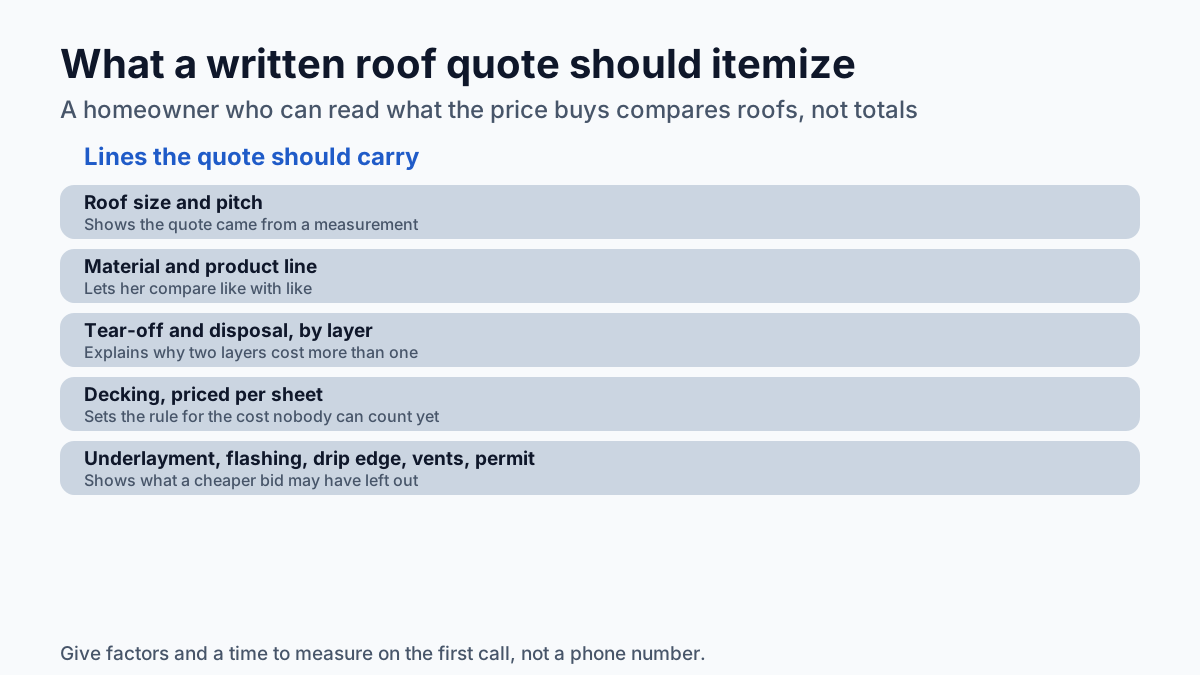
Then make the written quote do the selling. A homeowner who can read what the price buys can compare scope to scope. One who gets a single number at the bottom of a page can only compare that number. A quote that answers questions before they get asked usually covers:
| Line | Why the homeowner needs to see it |
|---|---|
| Roof size and pitch | Shows the quote came from a measurement |
| Material and product line | Lets her compare like with like |
| Tear-off and disposal, by layer | Explains why two layers cost more than one |
| Decking, priced per sheet | Sets the rule for the one cost nobody can count yet |
| Underlayment, flashing, drip edge, vents | Shows what a cheaper bid may have left out |
| Permit and inspection | Shows the job is being done on the record |
Speed matters as much as clarity. The homeowner from Mandarin is reading quotes in the order they arrive.
Is a high roof quote too much?
Nobody can say whether $30,000 is too much without the scope behind it; the same figure can be fair on one house and high on another, and the line items are how a homeowner tells which.
When a homeowner says a number like that out loud, treat it as a request to see what the price buys. Often it means she has a lower bid on the counter, or a range she read online. Do not cut your price first. Walk the quote line by line and ask to see the other bid's scope. Is it the same product line? Does it include new flashing and drip edge, or reuse the old? Does it price decking, or leave that open?
A good roofer wins this conversation with specifics. A homeowner who understands that the other bid skipped the underlayment upgrade, or carries no decking allowance, stops comparing totals and starts comparing roofs. If your number is still higher after that, you can say so plainly and explain where the difference goes. Many owners will pay for a roof they understand over one they do not.
What is the most expensive part of replacing a roof?
Materials and labor make up most of a re-roof's price, but the line that causes the most trouble in a sales conversation is damaged decking, because nobody can count the bad sheets until the old roof is off.
Decking is where trust gets won or lost. A homeowner who signs a quote and then gets a phone call mid-tear-off saying the job grew can feel ambushed, even when every sheet you replaced was soft. The fix is to handle it before the job starts.
Put a per-sheet price for decking in the written quote. Say on the first visit that you will not know the count until tear-off, and that you will show her the sheets. Then do it: photograph the damaged decking and send the pictures the same day, with the count. On houses with a history of leaks around plumbing boots or chimney flashing, say up front that rot under those spots is likely. A homeowner who was told what to expect, and then shown it, sees a careful contractor. One who was surprised sees a bill.
What is the cheapest way to replace a roof?
The cheapest honest way to replace a roof is to match the material and scope to the house and the owner's plans, from a measured quote; a contractor who offers to waive the insurance deductible to land the job is breaking Florida law.
On the honest side, a roofer has several options to offer a price-sensitive homeowner. An owner planning to sell in a few years may not need the same material as one planning to stay for twenty. A flexible start date lets you fit the job around your crews' schedule. Laying out two or three options on the same quote, each fully itemized, lets the homeowner pick a budget without feeling pushed.
On the other side sits a set of shortcuts Florida has closed. A contractor may not offer a homeowner a rebate, gift card, cash, coupon or deductible waiver, or any other thing of value, in exchange for letting the contractor inspect the roof or for making an insurance claim. A contractor can receive up to a $10,000 fine for each violation. If a homeowner says another company offered to "take care of the deductible," you can tell her what the law says and move on to your quote.
What time of year is the cheapest to replace a roof?
No month guarantees a lower price; what moves with the calendar is demand, and in Northeast Florida demand follows the Atlantic hurricane season, which runs from June 1 to November 30.
The Atlantic hurricane season dates shape how homeowners think about their roofs. Plenty of owners only start asking prices after water comes through a ceiling, and summer storms bring a lot of those calls at once. By then, every roofer in town is chasing them.
The mistake many companies make is treating storm season as the only selling season and going quiet from December through May. Those months are when you can work the homes with aging roofs that have not failed yet. The owner of a house built in the late 1990s in Mandarin or on the Southside, with its original roof or one replaced long ago, has no water on the ceiling and no reason to shop. That is the homeowner who will listen to a measured quote without three other roofers in her driveway, and your crews have open dates to offer her.
When she asks whether winter is cheaper, the honest answer is that scheduling is easier when crews are not booked behind storm work, and that a roof replaced on her schedule beats one replaced on the weather's.
What is the lifespan of a new roof?
A roof's lifespan depends on the material, the installation and the exposure, and in Florida a roof's age also matters to the homeowner's insurer, because state law sets specific rules for roofs at least 15 years old.
This is the question where a roofer can be most useful without selling anything. Florida law says that for a roof that is at least 15 years old, an insurer must allow the homeowner to have a roof inspection performed by an authorized inspector, at the homeowner's expense, before requiring the roof to be replaced. If that inspection shows the roof has 5 years or more of useful life remaining, the insurer may not refuse to issue or renew the policy solely because of the roof's age.
Two things follow for your sales team. First, never tell a homeowner that Florida law requires a new roof at 15 years. It does not, and the homeowner who later learns that will not trust your next quote. Second, the age question is a door opener. A homeowner with a roof past 15 years, or one getting close, has a reason to want a professional opinion now. Give her a straight answer. If the roof has years left, say so in writing. If it does not, she already trusts the person who told her.
Leave the reading of her policy to her agent. Your part is the roof.
Is roof replacement tax deductible?
Send that question to the homeowner's tax preparer; a roofer should not give tax advice, and the useful thing you can provide is a clean, itemized invoice plus the permit record for the job.
Homeowners see headlines about tax breaks and ask the contractor in front of them. The same answer covers every version of the question, including whatever new break she read about this week. Tell her you do not give tax advice, that her preparer is the right person to ask, and that your paperwork will show exactly what was installed and when. A detailed invoice with the material, the scope and the permit number is worth more to her preparer than any guess you could offer at the kitchen table.
How do you reach homeowners before they start comparing prices?
Work the homes whose roofs are likely due before the owner starts searching, because a homeowner who has not called anyone yet compares your quote with nothing.
Most of the price pressure in this post comes from timing. The homeowner typing a price question into her phone is already shopping. The one whose 20-year-old shingles are curling but not leaking has not called anybody. Reaching her first changes the whole conversation.
Shared leads, Google ads and lead sites work, and plenty of good roofers use them. They are fast and priced per lead, and the homeowner on the other end has often already reached out to other roofers. Owned prospecting is the volume nobody else is working. Public building permit and property records can tell you roughly when a house was built and when, if ever, its roof was last permitted. From there, the move is to pick the streets where roofs are likely due and work those with door hangers, mailers or a canvass, instead of blanketing a whole ZIP and paying to reach houses with new roofs.
Track what each source costs you per signed job, not per lead. A cheap lead that three companies are racing for can cost more per signed job than a canvass of forty homes nobody else is knocking.
If you want that list built for you, Roof Identifier ranks Duval County homes by how likely the roof is due for replacement, and Territory Lock keeps your ZIP to one roofer while it is yours; you can ask for a free ZIP Roof Report for your ZIP or check whether your ZIP is still open.
Frequently asked questions
Can a Florida roofer waive the insurance deductible to win a re-roof?
No. Florida law bars a contractor from offering a rebate, gift card, cash, coupon, deductible waiver or other thing of value in exchange for a roof inspection or an insurance claim, with fines of up to $10,000 per violation.
Does Florida law require a new roof at 15 years?
No. For a roof at least 15 years old, an insurer must let the homeowner have an authorized inspector inspect the roof at the homeowner's expense before requiring replacement, and an inspection showing 5 or more years of useful life means the insurer may not refuse to issue or renew solely because of roof age.
How should a roofer handle decking costs on a quote?
Put a per-sheet decking price in the written quote, say on the first visit that the count is unknown until tear-off, and send photos and the count the same day the bad sheets are found.
Should a roofer answer a homeowner's tax questions about a new roof?
No. Tell the homeowner you do not give tax advice and that her tax preparer is the right person to ask. What you can provide is a clean, itemized invoice with the material, the scope and the permit number.