
Canvassing training for a roofing company prepares canvassers to knock the right doors, deliver a practiced opener, set inspections and stay inside Florida's solicitation rules. A solid program covers the shift goal, the territory, script roleplay, the legal rules on gifts and cancellation notices, heat safety, and a daily debrief that tracks doors, conversations, inspections set and cost per signed job.
A lot of canvassers learn the job from one ride-along and a script saved in their phone notes. That gets a new rep to the door. What it leaves out is the part a sales manager can fix in one morning: where to knock, what to say when the homeowner pushes back, what Florida law bars, and how to tell on Monday whether Saturday paid for itself.
What should a roofing canvass training cover?
A roofing canvass training should leave every rep able to name the day's goal, explain why they are on these streets, run the script without reading it, follow Florida's rules, stay safe in the heat and report clean numbers after the shift.
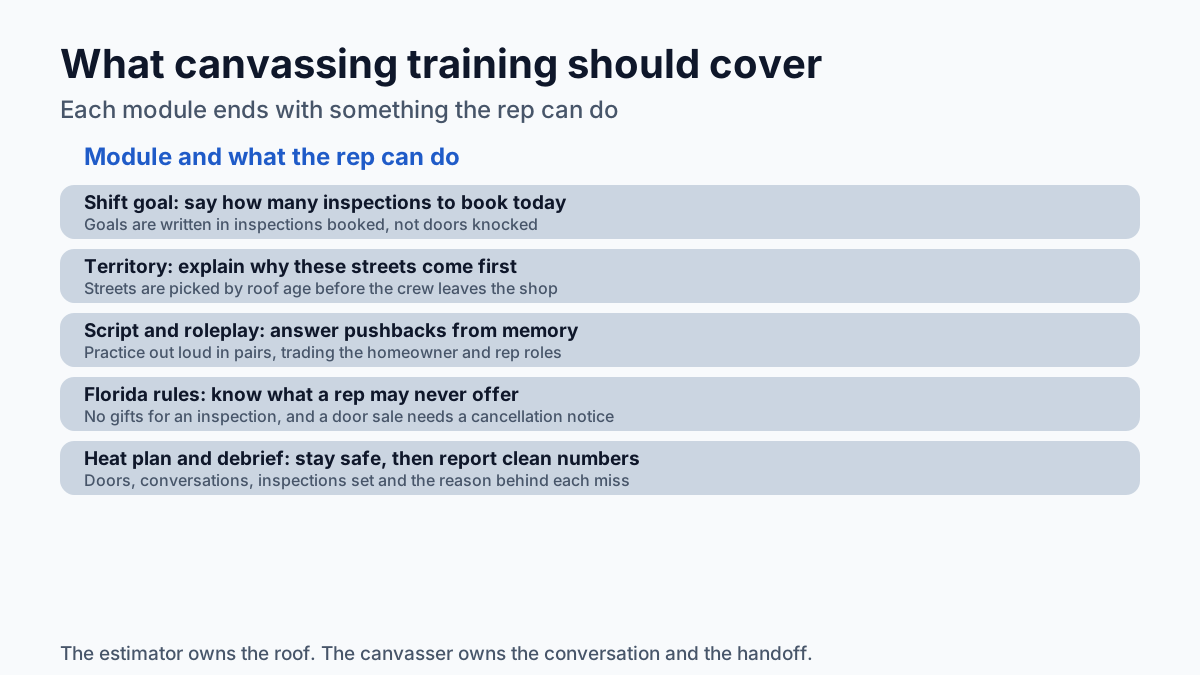
| Module | What the rep can do afterward |
|---|---|
| Shift goal | Say how many inspections they are expected to book today |
| Territory | Explain why these streets were picked and which houses come first |
| Script and roleplay | Deliver the opener and answer the usual pushbacks from memory |
| Florida rules | Know what they may never offer, and what paperwork a door sale needs |
| Heat plan | Follow the water, shade and check-in routine |
| Debrief | Report doors, conversations, inspections and why the misses missed |
Your canvassers will know less about roofing than your estimators, and that is fine. Train them on the conversation and the handoff. The estimator owns the roof.
How do you set a goal for each canvassing shift?
Set every shift goal in inspections booked, because doors knocked only measures effort, while inspections show whether that effort was pointed at houses that need a roof.
Picture two reps on the same Saturday. One knocks 40 doors in a 1990s subdivision in Mandarin and books two inspections. The other covers 90 doors scattered across a mixed ZIP and books none. The second rep worked harder and the first had the better day, and a goal written in doors would have praised the wrong one.
That is why territory belongs in the training session as well as the morning text. Pick the streets by roof age before the crew leaves the shop, and make sure each rep can say in one sentence why those houses come first. The step-by-step of working a house once the rep is on the porch is covered in our guide on how to sell roofs door to door, so this session can stay on preparation.
How should canvassers practice the script?
Canvassers should practice out loud in pairs, trading the homeowner and rep roles, until they can deliver the opener and answer each common pushback without glancing at a phone.
The pushbacks are predictable enough to rehearse. The homeowner says the roof is fine. They already have a roofer. They might sell next year. Or the door starts closing before the rep finishes a sentence. Write a two-line answer for each, have the pair run it five times, then switch roles. A rep who has heard the objection from the other side of the door answers it more calmly.
Keep the canvasser's job narrow. The goal at the door is a booked inspection with a name, a time and a phone number the homeowner chose to give. Questions about pricing go to the estimator or the office. Questions about insurance coverage or a claim go to the homeowner's insurer or agent, because Florida bars a contractor from interpreting coverage, and the script should say so in plain words. Review the script every week, and drop any line that is not booking appointments.
What Florida rules should canvassers learn before the first shift?
Florida canvassers should learn two state laws before their first shift: section 489.147, on what a contractor may offer for a roof inspection or claim, and the home solicitation sale rules in sections 501.021 and 501.031, which give door-sold buyers a cancellation window.
Under 489.147, a contractor may not offer a residential property owner a rebate, gift, gift card, cash, coupon or insurance deductible waiver in exchange for allowing a roof inspection or making an insurance claim. Roof-claim solicitation material must carry the statute's required disclosures in a font at least 12 points and at least half as large as the largest font used, so check every door hanger and leave-behind before a crew carries a box of them. A contractor can be fined up to $10,000 for each violation of the section.
The second rule kicks in when a contract gets signed at the kitchen table. Florida treats a sale over $25 that is solicited in person and completed away from the seller's place of business as a home solicitation sale. The agreement must tell the buyer they can cancel "before midnight of the third business day after you sign this agreement." That cancellation notice has a federal twin: the FTC treats failing to give buyers disclosures about the three-business-day right to cancel as an unfair and deceptive practice.
A canvasser who only books inspections may never touch a contract, but they need to know these rules exist so they never promise something that contradicts them. Have your attorney review the contract and the printed pieces once, then teach the result as a short checklist.
How do you keep a canvass crew safe in summer heat?
Build a written heat plan into training and run it on every summer shift, because OSHA says employers should create plans to protect workers from developing heat-related illnesses, and a crew walking open streets all afternoon needs one.
A new rep in a dark polo on a street of slab homes with no tree cover tires fast, and a tired rep gets short with homeowners. Keep water and shade on the truck, schedule breaks instead of leaving them to the rep, and have reps text a check-in on a set interval. Splitting the summer shift into a morning block and a late-afternoon block keeps reps off the street through the hottest stretch of the day. Add a rule for when lightning shows up, so nobody has to make that call alone on a cul-de-sac in Arlington.
How do you know if canvassing training is working?
The training is working when cost per signed job comes down, and the way to see that is a short daily debrief where each rep reports doors knocked, conversations, inspections set and the reason behind each miss.
Figure cost per signed job the same way for every lead source: rep pay, mileage, printing and manager time for the canvass, divided by the jobs signed from it. Then compare it against your shared leads and mailers, figured the same way. Door knocking is slow, and the honest comparison is the only way to see what it earns you.
The ratios also tell you what to coach next. A rep with plenty of conversations and few inspections needs script work. A rep with few conversations needs better streets or better hours. Move the training to wherever the numbers say the shift is leaking.
Training goes faster when the streets are picked before the meeting starts. Roof Identifier can send a free ZIP Roof Report for your ZIP, and with Territory Lock, no other roofer can buy that ZIP from us while it is yours.
Frequently asked questions
Can a roofing canvasser offer a gift card for a roof inspection in Florida?
No. Section 489.147 bars a contractor from offering a residential property owner a rebate, gift, gift card, cash, coupon or insurance deductible waiver in exchange for allowing a roof inspection or making an insurance claim, and a contractor can be fined up to $10,000 for each violation.
What number should a canvassing shift goal be written in?
Write the goal in inspections booked. Doors knocked only measures effort, while inspections show whether the effort was aimed at houses that need a roof.
Does a roofing contract signed at the homeowner's house need a cancellation notice?
Yes. In a Florida home solicitation sale, the agreement must tell the buyer they can cancel before midnight of the third business day after signing, and the FTC treats failing to give three-business-day cancellation disclosures as an unfair and deceptive practice.
What should a canvasser say when a homeowner asks about insurance coverage at the door?
Tell the canvasser to send coverage and claim questions to the homeowner's insurer or agent, because Florida bars a contractor from interpreting coverage. Keep the door goal narrow: a booked inspection with a name, a time and a phone number the homeowner chose to give.