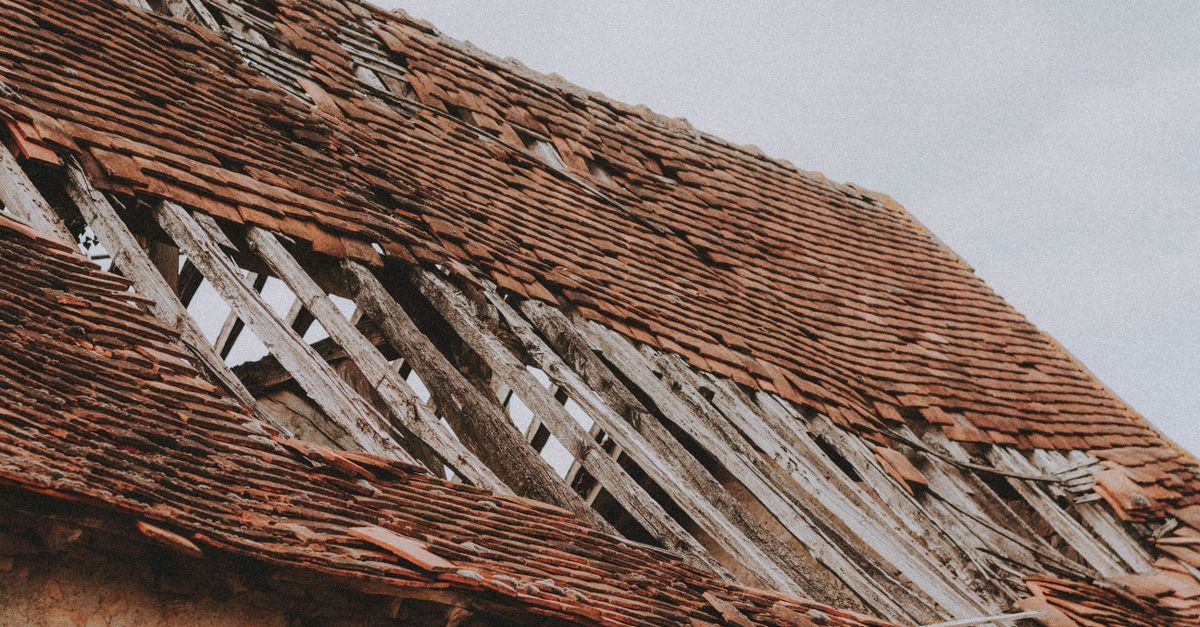
Replace roof shingles when cracked, curled or missing shingles show up across the whole roof instead of one patch, or once a residential roof is more than 20 years old, which the Asphalt Roofing Manufacturers Association (ARMA) calls a prime candidate for reroofing. In Florida, a 15-year-old roof is not automatically due for replacement.
Those two signals decide most re-roof conversations before anyone sets a ladder. The homeowner can see the first one from the driveway. The second is where a lot of sales stall, because homeowners have heard there is a 15-year rule in Florida and either assume their clock has already run out or assume it never will. The roofer who can explain both, plainly and correctly, is the one who gets the signed contract.
Take a hypothetical: a two-story in a 1990s Mandarin subdivision, original roof or close to it, with an oak limb that has been brushing the back slope for years. The owner calls about one stain on a bedroom ceiling. Your job is to figure out, in front of them, whether that is a repair or the start of a replacement.
How do you know when your roof shingles need to be replaced?
Shingles need replacing when the damage is spread across the roof, meaning cracking, curling and missing shingles on several slopes, rather than one torn tab over the garage after an afternoon thunderstorm.
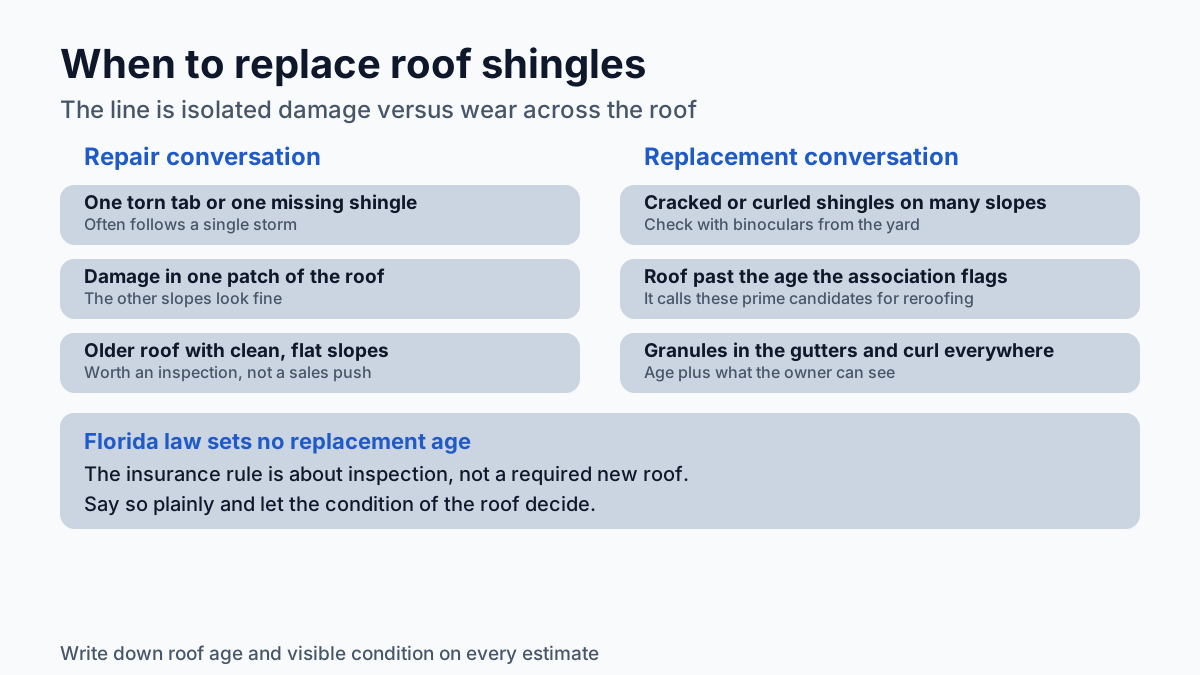
That line between isolated damage and wear everywhere is the line between a repair ticket and a re-roof. It is also the line the homeowner is trying to draw, usually without knowing what they are looking at.
ARMA's advice to homeowners is to stay off the roof and walk around the home with binoculars looking for cracked, curled or missing shingles. Use that. Stand in the driveway with the owner, hand them the binoculars, and point them at the slope that takes the afternoon sun. A homeowner who has seen the curl with their own eyes stops wondering whether you are selling them something they do not need.
Then show them the slope that looks fine, if there is one. Being candid about the good parts of a roof is what makes your read of the bad parts believable.
My roof is 20 years old. Should I replace it?
A shingle roof past 20 years should be priced for replacement, because ARMA calls any residential roof more than 20 years old a prime candidate for reroofing. Whether it goes this year or next depends on what the slopes show.
Age gets you in the door. It rarely closes the job by itself. A roof that has sat through 20-plus Jacksonville summers with clean, flat shingles is a different conversation from one at the same age with granules in the gutters and curl on every slope. Pair the age with what the homeowner just saw through the binoculars, and the recommendation stops sounding like a pitch.
Write down the age and the visible condition on every estimate, signed or not. A 19-year-old roof you passed on this spring is a strong lead next spring.
Does a 30 year shingle really last 30 years?
Do not count on it. The rating on the bundle describes the product, and ARMA still treats any residential roof past 20 years as a prime candidate for reroofing.
In a lot of driveways, the owner will tell you the roof has 30-year shingles on it. Arguing with the label wins nothing. Walk the owner through what the roof looks like today, slope by slope, and let the condition answer the question the label raised.
What does Florida's 15-year roof rule actually say?
For a roof at least 15 years old, the insurer must let the homeowner have the roof inspected by an authorized inspector, at the homeowner's expense, before requiring replacement as a condition of issuing or renewing the policy. The rule covers policies issued or renewed on or after July 1, 2022, and roof age counts from the last time 100 percent of the roof was replaced.
The second half of the rule matters just as much. The insurer may not refuse to issue or renew solely because of roof age if that inspection shows the roof has 5 years or more of useful life remaining.
So Florida law does not require a roof to be replaced at 15 years. Say that out loud when a homeowner brings it up, even when it costs you a quick sale. A 16-year-old roof with clean slopes is an inspection conversation. A 22-year-old roof with curl on every slope is a replacement conversation on its own merits, and you do not need the statute to make it.
Leave questions about what a specific policy covers to the homeowner's insurance agent. Your lane is the condition of the roof.
What is the 25% rule in roofing?
In Florida, if a roof was built, repaired or replaced to the 2007 Florida Building Code or later, and 25 percent or more of it is being repaired, replaced or recovered, only that portion must meet the current code.
That language comes from Florida's 25 percent roof rule, and it matters when you scope a large repair on a newer roof. A big repair on a post-2007 roof does not, by itself, pull the untouched slopes up to today's code. The carve-out is written for roofs done to the 2007 code or later, so on anything older, check the current Florida Building Code before you write the estimate.
How to tell if a roofer is lying?
Homeowners decide whether a roofer is being straight by checking what you say against what they can see and what they can look up, so give them both.
Photograph every slope, including the good ones. Point to damage they can confirm through binoculars from the yard. Describe the 15-year rule the way the statute does, and never tell anyone the law says they need a new roof. Most homeowners have read something online before you knock, and a roofer whose claims hold up against their own reading earns the callback.
Where do you find the homes whose shingles are due?
The homes to work first are the ones whose roofs are past 20 years, on streets where most houses went up around the same time and few have re-roofed since.
A subdivision built in one burst tends to age in one burst. If three houses on a street in Arlington have fresh roofs and the other twenty do not, the other twenty are your canvass. Look up the re-roof permit history for one ZIP, mark the streets, and send your canvassers there this week instead of knocking the whole ZIP.
If you would rather start from a ranked list than drive every street, Roof Identifier will send a free ZIP Roof Report for your ZIP, and you can check whether your ZIP is still open while you are at it.
Frequently asked questions
Does Florida law require replacing a roof at 15 years?
No. For a roof at least 15 years old, the insurer must allow an inspection by an authorized inspector before requiring replacement, and it may not refuse to issue or renew solely because of roof age if that inspection shows 5 or more years of useful life remaining.
Who pays for the roof inspection under Florida's 15-year rule?
The homeowner. The statute says the inspection by an authorized inspector is performed at the homeowner's expense.
Is one missing shingle a reason to replace the whole roof?
One missing shingle or one damaged patch is a repair conversation. Replacement comes into the picture when cracking, curling or missing shingles show up across several slopes, or the roof is more than 20 years old.
Does Florida's 25 percent rule apply to every roof?
The statute's wording covers roofs built, repaired or replaced to the 2007 Florida Building Code or later. For those roofs, when 25 percent or more is repaired, replaced or recovered, only that portion must meet the current code.