Architectural shingles have no single lifespan. The 30-year or lifetime rating on the bundle is a limited warranty against manufacturing defects, and service life in Northeast Florida depends on attic ventilation, installation and heat. For a roofer, the age that matters more in a sale is 15 years, the roof age below which Florida law bars an insurer from refusing a homeowner policy solely because of roof age.
Picture a driveway in a 1990s Mandarin subdivision. The owner put on a 30-year architectural shingle and figures the roof is good until the label runs out. From the street you can see bare, darker patches on the south slope. Arguing about the label loses that conversation. Giving the owner something they can check wins it.
What makes an architectural shingle last longer than a 3-tab?
An architectural shingle is a dimensional shingle, which CertainTeed describes as a dual-layered product that is typically heavier than a single-layer 3-tab and usually carries better warranty protection, from 30 years to Lifetime.
The label still describes coverage, not service life. Our post on shingle roof life expectancy covers that warranty question in full, so the short version is all you need in a driveway.
What the second layer does not do is cool the attic. A laminated shingle sits on the same deck a 3-tab would, and a hot, poorly vented attic under it works on both. None of the warranty paperwork changes the heat load on a Jacksonville attic in August, or whether the original crew installed the vents the roof needed.
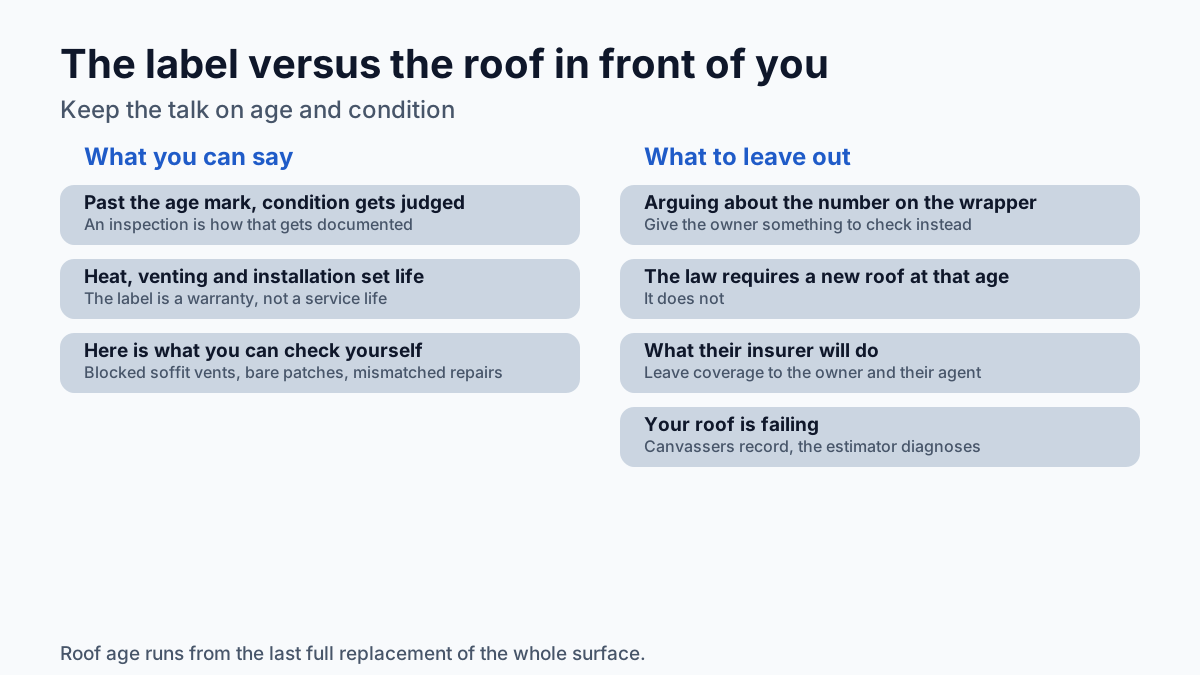
So do not fight the number on the wrapper. Homeowners anchor to it because it is the only number anyone ever gave them. Tell them plainly that the roof's actual condition is something an inspection measures. Then show them what to look at.
What shortens an architectural shingle roof in Northeast Florida?
Heat and trapped moisture shorten shingle life, and attic ventilation is the factor a roofer can check on the first visit.
The Asphalt Roofing Manufacturers Association, the shingle makers' trade group, says a balanced system of intake and exhaust keeps air moving through an unconditioned attic, "helping to reduce heat and moisture buildup year-round and prolong the life of the roofing system."
That line is useful on a sales call because it comes from the people who make the shingles, and because ventilation is visible. Soffit vents painted shut or packed with debris. A ridge vent with no intake below it. A row of box vents added years ago with nothing balancing them. In a Jacksonville summer, an attic with no balanced airflow has months to bake and hold moisture, which is the condition the manufacturers' group is describing.
When you find a ventilation problem on an aging architectural roof, you have an explanation the homeowner can see, and a reason the new roof should be built differently.
What are the different types of shingle damage a canvasser can spot?
From the street, a canvasser can usually spot granule loss, lifted or creased shingles along rakes and ridges, missing pieces after wind, and repairs in mismatched colors.
Teach canvassers to record what they see and leave the diagnosis to your estimator. A short note does it: south slope, bald patches, two missing on the rake, patched near the chimney. That gives the estimator a reason to come back and a way to open the conversation. A canvasser who tells a homeowner the roof is failing has said more than they know, and the homeowner can tell.
Keep that first conversation on the roof's age and condition. It is a cleaner pitch, and it holds up when the homeowner talks to a neighbor or their agent.
What does Florida's 15-year roof rule mean for an architectural shingle roof?
Florida law bars an insurer from refusing to issue or renew a homeowner's policy solely because of roof age when the roof is less than 15 years old, so 15 is where an architectural roof's age starts to count on its own.
Past that mark the statute still gives the homeowner something. For a roof at least 15 years old, the insurer must let the homeowner have the roof inspected by an authorized inspector, at the homeowner's expense, before requiring replacement as a condition of the policy. And if that inspection shows 5 years or more of useful life remaining, the insurer may not refuse to issue or renew solely because of roof age.
This is why a 30-year label and a 15-year statute end up in the same driveway conversation. Never tell a homeowner the law requires a new roof at 15, because it does not, and never tell them what their insurer will do. What you can say is accurate and useful: once the roof passes 15, its condition is what gets judged, and an inspection is how that condition gets documented. Leave coverage questions to the homeowner and their agent.
If you want the permit-year side of this, which years of roofs to prospect this season, our post on shingle roof life expectancy covers it.
Are architectural shingles good?
Architectural shingles are a sound re-roof choice, and a homeowner who already has them knows what they look like, so the conversation is mostly about timing and installation rather than product.
When an owner asks why their roof aged faster than the label suggested, the honest answer usually points at heat, ventilation and installation, and all of those are things a careful contractor controls on the next roof. That gives you a better pitch than any brand comparison: same product family, built with balanced intake and exhaust, installed by a crew that will be around to answer the phone. If the owner wants to talk about metal instead, that is a different sale, and we cover it in our post on metal roofs in Florida.
Which architectural shingle homes should you work first?
Work architectural shingle homes whose roofs are at or past 15 years and show visible wear first, because those owners have both a legal reason and a visible reason to listen.
Roof age alone puts a house on the list. Visible wear and a ventilation problem you can point to move it to the top. A street where a dozen homes were re-roofed within a few years of each other is worth a Saturday, because those roofs crossed 15 together and the neighbors will compare notes. Roof age under the statute runs from the last time the whole roof surface was replaced, so a permit year for a full re-roof is the date that counts.
Finding those streets without driving every block is the work Roof Identifier does. It ranks Duval County homes by how likely the roof is due, and Territory Lock keeps a ZIP to one roofer while it is yours. Ask for a free ZIP Roof Report for your ZIP, or check whether your ZIP is still open.
Frequently asked questions
Is the 30-year rating on architectural shingles a lifespan?
No. The rating on the bundle is the length of the manufacturer's limited warranty against manufacturing defects, and Owens Corning's warranty, for one, does not cover damage caused by improper installation or inadequate roof ventilation. Actual service life in Northeast Florida depends on attic ventilation, installation and heat.
Does Florida law require a roof to be replaced at 15 years?
No. Florida law bars an insurer from refusing to issue or renew a homeowner's policy solely because of roof age when the roof is under 15 years old. For a roof at least 15 years old, the insurer must let the homeowner have it inspected by an authorized inspector, at the homeowner's expense, before requiring replacement.
What happens if an inspection finds 5 years of useful life left on a 15-year-old roof?
If the inspection shows 5 years or more of useful life remaining, the insurer may not refuse to issue or renew the homeowner's policy solely because of roof age. Leave any coverage questions to the homeowner and their agent.
Why does attic ventilation matter for architectural shingle life?
The Asphalt Roofing Manufacturers Association says a balanced system of intake and exhaust helps reduce heat and moisture buildup year-round and prolong the life of the roofing system. Ventilation is also visible, which makes it a useful opening on a sales call.