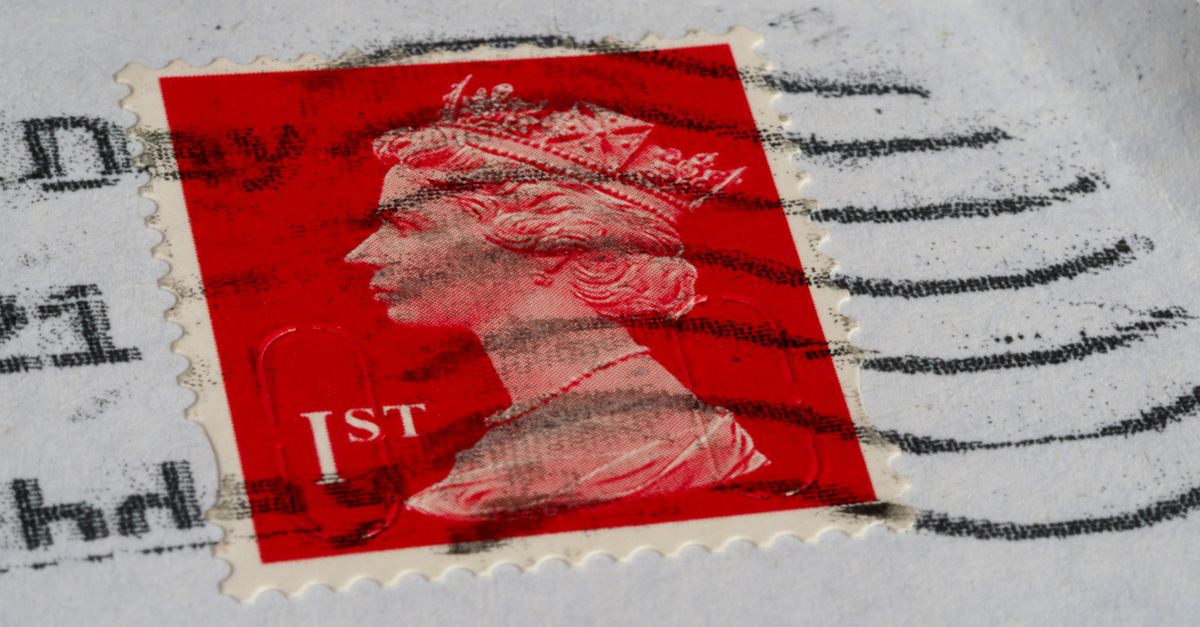
An EDDM indicia is the USPS-approved printed postage mark required on each Every Door Direct Mail Retail piece. It prints above and to the right of the simplified address block. At Retail, USPS accepts only its approved Retail indicia, so your company's own mailing permit imprint will be refused.
Picture a sales manager with boxes of oversized postcards stacked in the shop, printed for three carrier routes through an Arlington subdivision where most houses still carry their original roof. If the printer put the company's permit imprint in the corner instead of the Retail indicia, the post office will not accept the stack, and the print bill is spent on cards that cannot go out as EDDM Retail. That small box in the upper right is the cheapest thing on the card to get right.
Some background for anyone new to it. Every Door Direct Mail (EDDM) is the USPS program that delivers one piece to every address on the carrier routes you pick. The pieces carry no homeowner names or street addresses. Retail is the version a business can bring to a post office without a mailing permit. The rest of this post covers the indicia itself and the Retail rules that travel with it.
What does an EDDM indicia do on a mailpiece?
The indicia is the required postage mark on an EDDM Retail piece: it shows the piece is being mailed under EDDM Retail.
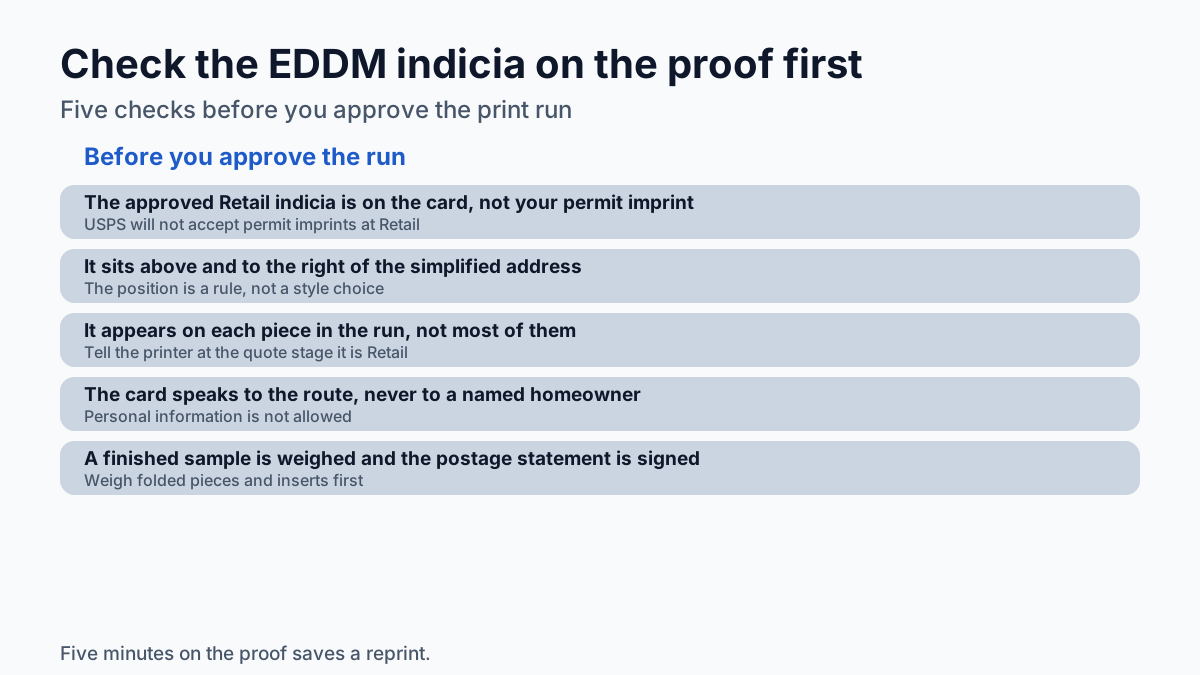
The Domestic Mail Manual is specific about where it goes. A postage indicia must be on each piece, printed above and to the right of the simplified address. The simplified address is the generic delivery line EDDM uses in place of a name and street, since the piece goes to every door on the route rather than to one named person.
Two practical habits keep this clean. First, tell your printer at the quote stage that the job is EDDM Retail, so the Retail indicia is in the template from the first proof. Second, do not let a designer slide it somewhere else to make room for a roof photo or a bigger headline. The position is a rule, not a style choice. Plan the address side around it: indicia in the upper right, simplified address under and to the left of it, and your license number, offer and phone number in the space that remains.
Use the approved Retail indicia as USPS publishes it, and do not redraw it. If anything about it looks off on the proof, fix it before the run, not at the counter with a pallet of printed cards in the truck.
What are the requirements for a USPS permit indicia?
For an EDDM Retail mailing, a permit indicia is not an option at all: USPS does not accept mailing permit imprints at Retail, and it does not accept Marketing Mail permits for any EDDM Retail transaction.
The USPS EDDM terms and conditions put it in one line: "The approved Retail Indicia must be on each mailpiece, Mailing Permit Imprints will not be accepted at Retail." The same terms add that USPS Marketing Mail permits are not accepted for any Every Door Direct Mail Retail transaction.
This trips up roofers who already mail addressed pieces under a company permit. The permit imprint on those jobs is correct for those jobs. It is wrong for a Retail EDDM run, and the two should never share a print file. If a print shop offers to print your permit on an EDDM job, ask which EDDM channel they are preparing the mailing for. Mailing under a permit belongs to the business-mail version of EDDM, which has its own limits and its own drop-off process; the differences between Retail and that route are covered in our post on EDDM Retail.
A good printer who does EDDM work regularly will ask you this question before you have to raise it. That is a fair test when you are choosing one.
Do I need a permit for EDDM?
You do not need a mailing permit for EDDM Retail, and there are no annual presort or mailing fees to mail pieces as EDDM Retail.
The Domestic Mail Manual says it directly: there are no annual presort or mailing fees for EDDM-Retail. You pay postage on the pieces you mail, plus whatever your printer charges.
For a roofing company, that low barrier is the point of Retail. You can mail one neighborhood, see whether the phone rings, and decide on the next route without paying an annual fee to keep the channel open. A company that mails every month and wants larger volumes may outgrow Retail, but the first test does not need a permit, a mail house or a contract.
What are the requirements for EDDM?
EDDM Retail requires the approved Retail indicia on every piece, flats of 3.3 ounces or less, at least 200 pieces per mailing, no more than 5,000 pieces per day per 5-digit ZIP Code, no personal information, and a signed PS Form 3587.
Here is how each rule reads from the sales side.
| Rule | What USPS requires | What it means for your mailer |
|---|---|---|
| Indicia | Approved Retail indicia on each piece, above and to the right of the simplified address | Every card in the run, not most of them. Check the proof. |
| Weight | Flats no more than 3.3 ounces | A single postcard flat is light; a folded piece or an insert needs weighing |
| Minimum | 200 or more pieces per mailing, except a mailing to all addresses in a 5-digit ZIP | One small subdivision route can be enough to test |
| Daily cap | Up to 5,000 pieces per day per 5-digit ZIP Code | A big ZIP gets split across days |
| Personal information | Not allowed in an EDDM-Retail mailpiece | No homeowner names, no house-specific roof details |
| Paperwork | PS Form 3587 completed and signed by the mailer | Fill it out before you get in line |
The weight rule comes from the Domestic Mail Manual: EDDM-Retail flats must weigh no more than 3.3 ounces. The same section sets the 200-piece minimum, with the exception for a mailing to all addresses in a 5-digit ZIP, and the cap of 5,000 pieces per day per 5-digit ZIP Code.
The daily cap matters if you plan to saturate a large Duval ZIP. When the ZIP holds more than 5,000 homes, plan a schedule that splits the drop across days. Most roofers are better off not saturating the whole ZIP anyway, which comes up again below.
The personal information rule shapes the message. The manual says personal information may not be included in an EDDM-Retail mailpiece. So the card cannot greet a homeowner by name or speak to one specific house. What it can do is speak to the route. A line such as many homes on this street were built in the late 1990s is a message about the neighborhood, and it lands with the homeowner who knows the roof on their house is that old.
Finally, the paperwork. Each mailing of EDDM-Retail flats must be accompanied by a postage statement, PS Form 3587, completed and signed by the mailer. The mailer is you, the business sending it, so whoever drops off the cards needs to know who signs.
How do you run an EDDM mailing with USPS?
You choose carrier routes, design a flat that fits the Retail rules, print it with the Retail indicia above and to the right of the simplified address, complete and sign PS Form 3587, and take the mailing to the post office.
In order, for a roofing company:
- Pick the routes. This is the step that decides whether the mailing pays. Choose routes that run through subdivisions where roofs are likely due, not the route that happens to pass your office. Our post on EDDM Retail walks through route picking and the Duval drop-off.
- Build the card around the address side. Indicia upper right, simplified address below it, license number where it is easy to read. Card size choices are in our post on EDDM size, and what to say on the card is in our post on EDDM postcards.
- Order a proof and check it against the rules in the table above, starting with the indicia.
- Print the run. If the piece is folded or carries an insert, weigh a finished sample before the full order.
- Fill out and sign PS Form 3587 for the mailing.
- Take the mailing in, keeping each 5-digit ZIP within 5,000 pieces per day.
Step one is where most of the money is won or lost. Steps two through six are about not getting the stack turned away.
How much does USPS charge for EDDM?
USPS charges a per-piece postage price for EDDM Retail, published in its current price list, and adds no annual presort or mailing fees on top.
Postage prices change, so check the USPS price list the week you mail rather than trusting a number from last year's quote. This post does not quote one for that reason. Postage is also only one line on the job. The printer's bill, the design time and the hours someone spends getting the mailing to the post office all count.
The number a roofing owner should watch is cost per signed job. Add up everything the mailing cost, then divide by the re-roofs that came from it. A mailing that costs more per piece but goes to the right streets can beat a cheaper one that goes everywhere. To know which calls came from which route, put a short route code on each version of the card or give each route its own tracking number. A route-level code is the same on every card on that route, so it names no homeowner.
What is the cheapest way to do EDDM?
The cheapest way to run EDDM is through Retail, with no annual fees, mailed only to the carrier routes where roofs are likely due instead of to a whole ZIP.
A ZIP can mix houses of very different ages, including some with recent roofs. Mailing all of it means paying postage and printing for homes that will not need a roof for years. A single ZIP can look like one market on a map and behave like several at the door.
So the savings come from route choice more than from cheaper cardstock. Cut the routes full of recent roofs and newer homes. Keep the routes where the housing age says roofs are coming due. The 200-piece minimum lets you start with a few hundred homes, read the response, and expand only into routes that earned it. That is slower than one big drop, and it is how a careful operator keeps the cost per signed job low.
Mail aimed this way is a solid channel for re-roof work. A homeowner whose roof is coming due may not have called anyone yet, and a card on the kitchen counter puts your company in front of them first.
What are the standard sizes for EDDM postcards?
EDDM Retail pieces are mailed as flats and must weigh 3.3 ounces or less; the size rules and the common card sizes roofers use are covered in our post on EDDM size.
For the indicia, size matters in one way: the card has to leave room for the indicia and the simplified address in the upper part of the address side, without crowding your license number or your offer. Lay out the address side first and fill the rest after.
Which indicia mistakes get an EDDM Retail mailing turned away?
The mistake that sinks a run outright is a permit imprint where the Retail indicia should be, because USPS will not accept mailing permit imprints at Retail.
The other common misses are quieter, and each one puts the mailing outside the Retail rules:
- The indicia sits somewhere other than above and to the right of the simplified address.
- Some pieces in the run are missing it. The rule is each piece.
- The card names a homeowner or speaks to one specific house.
- A finished piece with an insert weighs more than 3.3 ounces.
- More than 5,000 pieces go in for one 5-digit ZIP on the same day.
- Nobody completed and signed PS Form 3587.
Check the proof against that list before you approve the print run. It takes five minutes and saves a reprint.
Route choice is the harder half of an EDDM mailing, and that is where Roof Identifier fits: it ranks Duval County homes by how likely the roof is due for replacement, sells each ZIP to one roofer at a time, and you can ask for a free ZIP Roof Report for your ZIP to see which neighborhoods are worth the postage.
Frequently asked questions
Can I use my company's mailing permit imprint on an EDDM Retail postcard?
No. USPS will not accept mailing permit imprints at Retail, and every EDDM Retail piece must carry the approved Retail indicia instead.
What form do I bring with an EDDM Retail mailing?
Each mailing of EDDM-Retail flats needs a postage statement, PS Form 3587, completed and signed by the mailer, which is the business sending the cards.
What is the smallest EDDM Retail mailing I can send?
An EDDM Retail mailing needs at least 200 pieces, except when it goes to all addresses in a 5-digit ZIP Code. That minimum lets a roofer test a few routes before mailing more.
Can an EDDM postcard mention a homeowner's name or their specific house?
No. Personal information may not be included in an EDDM-Retail mailpiece, so the message has to speak to the route or neighborhood rather than to one named home.
Sources reviewed
- USPS EDDM terms and conditions
- USPS EDDM terms and conditions
- USPS Domestic Mail Manual 144, EDDM-Retail postage payment
- USPS Domestic Mail Manual 144, EDDM-Retail postage statement
- USPS Domestic Mail Manual 143, EDDM-Retail eligibility
- USPS Domestic Mail Manual 143, EDDM-Retail daily cap
- USPS Domestic Mail Manual 143, EDDM-Retail minimum quantity
- USPS Domestic Mail Manual 143, no personal information
- USPS Domestic Mail Manual 143, fees