
Don't build your sales plan around an insurance company handing you roofing leads. The insurance-related work you can win comes from the agents and adjusters who trust your inspections and from homes in your ZIP whose roofs are reaching the age insurers ask about.
Roofers who win insurance-related work in Florida get it two ways: a reputation with local agents and adjusters for honest roof inspections, with no referral money changing hands, and steady prospecting of homes whose roofs are aging, where Florida's 15-year roof-age rule opens a straightforward conversation with the homeowner.
What you can count on is a set of state rules that decide how insurance work gets sold, and a supply of houses in your ZIP whose roofs are reaching the age insurers ask about at renewal. Here is how to work both without tripping over the statute.
Do insurance companies give roofers leads?
Not in a way you can plan on, so no roofer should build a sales plan around being handed work by a carrier.
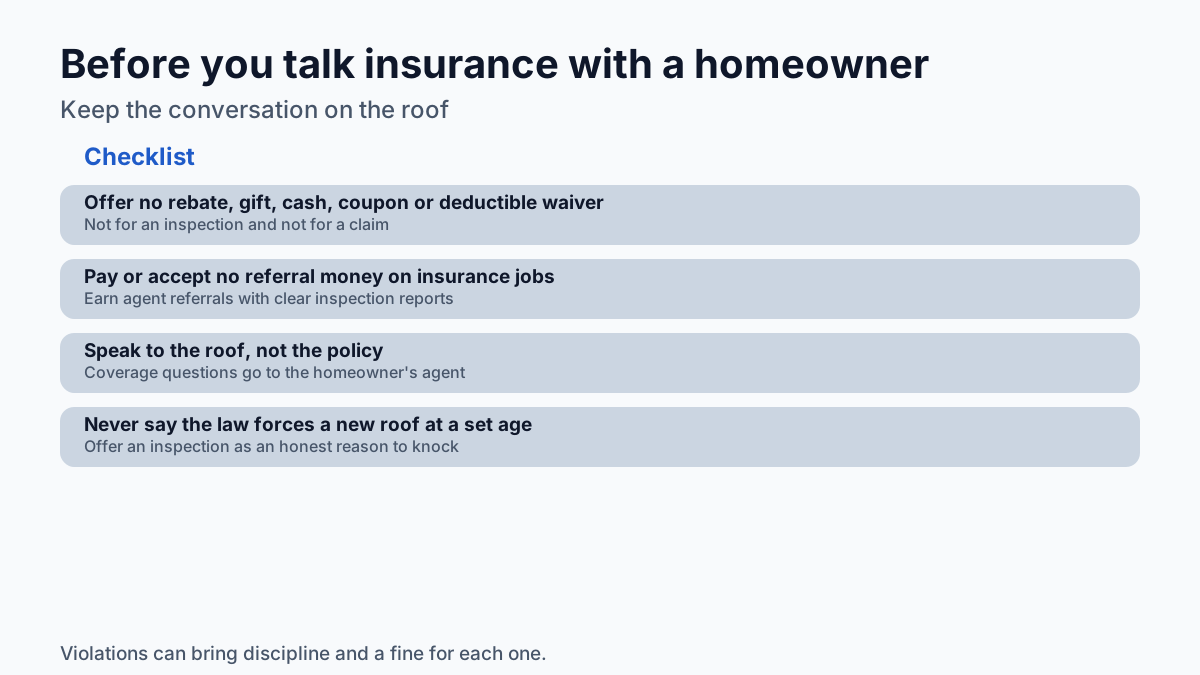
When people say insurance leads, they mean the people near a claim: the agent who wrote the policy and the adjuster who walks the roof. Neither one works for you, and Florida law limits what can pass between you. That leaves two honest channels. Be the roofer those people trust, and find the homeowners yourself.
Can you get referrals from insurance agents and adjusters?
You can earn referrals from agents and adjusters, but you cannot pay for them or take payment for them, because Florida's contractor law bars offering or accepting any compensation, inducement or reward for referring services paid with property insurance proceeds.
What earns the referral is work an agent can hand to a worried policyholder: an inspection report in plain language, dated photos of every slope, and a crew that shows up when it said it would. Stop by the independent agencies near the neighborhoods you already work, leave a sample report, and keep coming back.
Adjusters are a different relationship. Be on the roof when the adjuster arrives, have your measurements ready, and report only what you can see. An adjuster who has watched you call a roof straight has a reason to remember your name.
This channel builds slowly. It makes a good second source and a poor only source, which is why the rest of this post is about prospecting.
What can't a roofer offer or say in Florida insurance work?
A Florida roofer cannot offer a homeowner a rebate, gift, gift card, cash, coupon or insurance deductible waiver for an inspection or a claim, and cannot interpret a policy or advise on coverage without a public adjuster license.
The cost of getting it wrong is high. A contractor faces disciplinary action and a fine of up to $10,000 for each violation.
In practice, the rule changes the sales conversation more than the canvass. When a homeowner asks whether insurance will pay for a new roof, your answer is about the roof: what you found and what it needs. Coverage questions go to their agent. Saying so plainly helps you, because the homeowner can tell you are not angling for a claim.
How does Florida's 15-year roof rule create roofing leads?
Florida's roof-age rule points you at the homes to prospect, because an insurer cannot refuse to issue or renew a homeowner's policy solely because of roof age when the roof is less than 15 years old, and roofs past 15 face a stricter test.
For a roof at least 15 years old, the insurer must let the homeowner have it inspected by an authorized inspector, at the homeowner's expense, before requiring replacement. If that inspection shows 5 or more years of useful life left, the insurer cannot refuse the policy on roof age alone.
The rule does not require anyone to replace a roof at 15 years, and you should never say it does. What it gives you is an honest reason to knock. The owner of a house with a roof past 15 may be asked about it, and a roof inspection is a service you already sell. Under the same statute, a roofing contractor approved by the insurer can serve as an authorized inspector, and roof age counts from the last time 100 percent of the roof was replaced, for policies issued or renewed on or after July 1, 2022. Some of those inspections will show plenty of life left. That still works in your favor, because you are the roofer who told the truth, and the re-roof comes back to you when it is due. Others will show a roof that is done, and that homeowner needed a new roof either way.
How to generate leads for a roofing company?
The steadiest way to generate roofing leads is to find homes whose roofs are likely due, using public property and building permit records, and to work those streets by canvass and mail before another roofer gets there.
Property records give you the year a house was built. Permit records show whether anyone pulled a re-roof permit since. Put the two together and a ZIP stops being every door in it and becomes a short list of streets.
Take a subdivision in Mandarin or Arlington that was built out in the 1990s. If the permit history shows no re-roof on most of its houses, those are likely the original roofs, and they are well past the 15-year line. That is a Saturday canvass route and a mailer for the week after, and your canvassers spend their hours in front of the right houses.
Storm work comes in bursts. A roof crossing 15 years does not wait for a storm, so a list of aging roofs keeps you selling in the quiet months.
Shared leads and lead sites still have a place. They are fast, and the homeowner has already raised a hand. The trade-off is that you are racing other companies to the same homeowner. On a list you built from records, you are the first roofer at the door.
How much does it cost to get roofing leads?
Roofing leads cost what the channel charges plus the time to work them: shared leads are priced per lead, mail per piece, and canvassing in crew hours, so the number to watch is cost per signed job.
A cheap lead that several companies chase can cost more per signed contract than a pricier one you work alone. Track every channel the same way: total spend divided by signed jobs, by month. Do that for a quarter and you will know where the next dollar should go.
How can I get free leads for my roofing business?
The best free roofing leads come from work you already have: past customers, the neighbors around every tear-off, and public records anyone can search.
Every job you finish puts a dumpster and a crew on a street, and in a subdivision the houses around it were often built the same year. Door hangers on the homes nearby cost almost nothing, and those owners just watched your crew work. Permit and property records are free to search too, though turning them into a ranked list by hand takes hours most owners do not have.
That gap is what Roof Identifier fills: it ranks homes in Duval County by how likely the roof is due, and Territory Lock gives that list to one roofer per ZIP, so the homeowners on it are not being worked off the same list by another company. To see what it looks like for your area, ask for a free ZIP Roof Report for your ZIP, or check whether your ZIP is still open.
Frequently asked questions
Can a Florida roofer waive a homeowner's insurance deductible?
No. Florida's contractor statute bars offering a homeowner a deductible waiver, along with rebates, gifts, gift cards, cash and coupons, and each violation can bring a fine of up to $10,000.
Can I tell a homeowner what their insurance policy covers?
Not unless you hold a Florida public adjuster license. Keep the conversation on the roof's condition and send coverage questions to the homeowner's agent.
Does Florida law require a roof to be replaced at 15 years?
No. An insurer cannot refuse to issue or renew a policy solely on roof age when the roof is under 15 years old, and for an older roof it must allow an inspection by an authorized inspector, at the homeowner's expense, before requiring replacement.
Can I pay an insurance agent a referral fee for roofing jobs?
Not for jobs paid with insurance money. Florida's contractor statute bars offering, delivering, receiving or accepting compensation, inducement or reward for referring services paid with property insurance proceeds, and each violation can bring a fine of up to $10,000. Earn agent referrals with clear inspection reports and crews that show up on time.