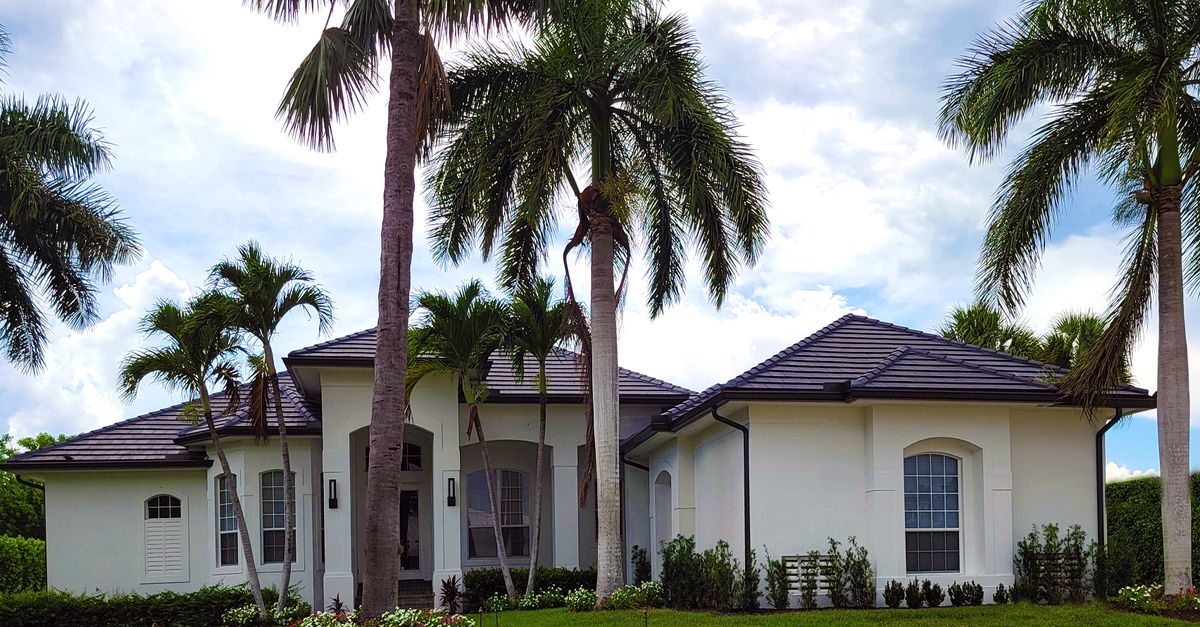
To get your own roofing leads, build sources you control: a Google Business Profile with job-site photos and reviews, a referral habit with past customers, and a list of homes whose roofs are likely due, worked by canvassing and direct mail. Paid ads and shared leads can sit on top of that base without replacing it.
"Own" is the word doing the work in that answer. A shared lead is a homeowner who filled out a form on a lead site, and that lead is sold to more than one roofer. You get speed, and you also get a race to the driveway. An owned lead is a homeowner you reached first: the neighbor of a job you just finished, a house on a street you picked, a call that came in from your own profile. Nobody else has that address, because nobody else did the work to find it.
How can I get free leads for my roofing business?
Your free leads come from the assets you already have: your Google Business Profile, your past customers, and the streets around the jobs your crews are working right now.
Start with the profile. Claim it, keep the service area honest, and post photos from actual jobs: the tear-off, the dry-in, the finished roof from the street. Ask every customer for a review the week the crew wraps up, while the new roof is still the best thing on the block. Steady reviews and fresh job photos keep your profile active and give a homeowner a reason to call you over the next listing, and both cost nothing but the habit.
Referrals work the same way. Ask at the final walkthrough, when the homeowner is happiest, and ask for a name, not a vague "send people our way."
Then use the job itself. A dumpster in a driveway tells the whole street a roof is coming off. Hang door hangers on the houses on either side and across the street that same week. In a subdivision where the homes went up within a few years of each other, the roofs tend to age together, so the house next door is often close behind.
How do you find homes whose roofs are likely due?
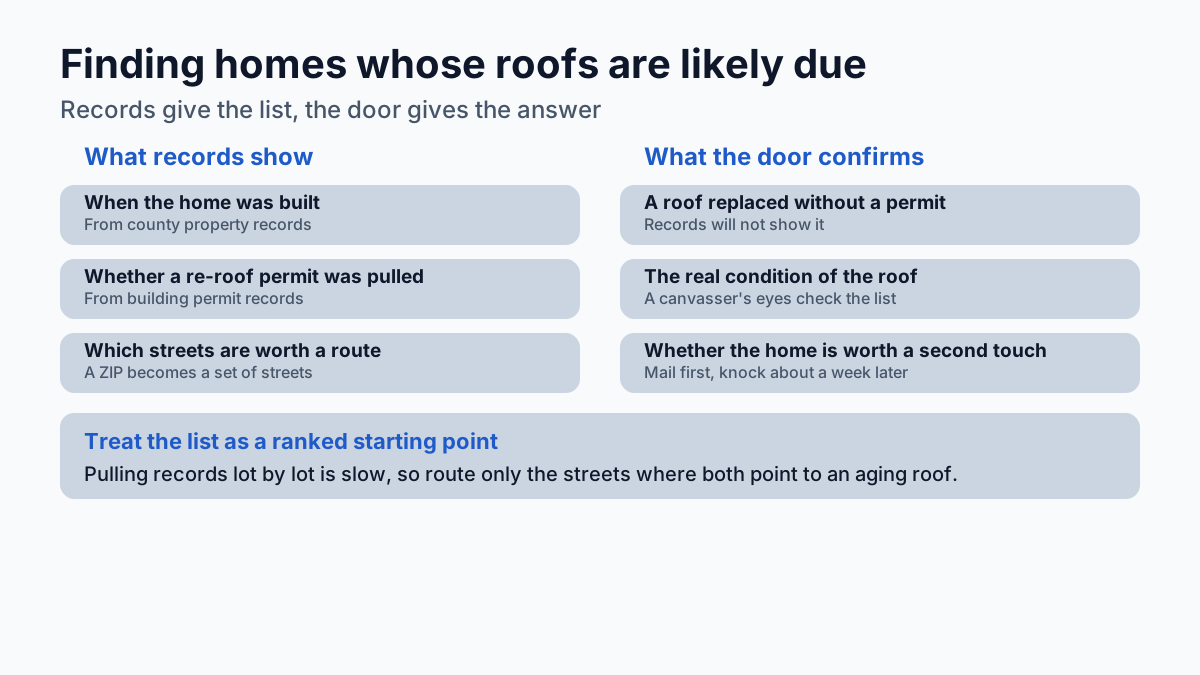
Find them by estimating roof age from public records: the year a home was built, from county property records, and whether a re-roof permit has been pulled since, from building permit records.
A house built in the late 1990s with no re-roof permit on file is a strong candidate. A house of the same age with a permit from a few years back is not. Run that check across a neighborhood and the map stops being a ZIP code and becomes a set of streets. That matters, because mailing or knocking a whole ZIP pays for every street when only some of them are due.
The catch is labor. Pulling records lot by lot is slow, and the records do not tell you everything (a roof replaced without a permit will not show up). Treat the list as a ranked starting point, then let your canvasser's eyes confirm it at the door.
What does Florida's roof-age insurance law mean for your sales conversation?
Florida law limits when an insurer can act on roof age alone, so the honest conversation is about the homeowner's options, never a claim that the state forces a new roof at 15 years.
Here is what the statute says. An insurer may not refuse to issue or renew a homeowner's policy solely because of the age of a roof that is less than 15 years old. For a roof at least 15 years old, the insurer must let the homeowner have an authorized inspector inspect the roof at the homeowner's expense before requiring replacement as a condition of the policy (the statute's list of authorized inspectors includes a roofing contractor). And if that inspection shows 5 or more years of useful life remaining, the insurer may not refuse to issue or renew solely because of roof age.
For a sales manager, this gives the canvasser something specific and accurate to say. A homeowner with a 17-year-old roof has a concrete reason to understand its condition before the next renewal. You are offering clarity, not a scare. Never tell a homeowner the law requires replacement, and never claim every insurer drops older roofs.
What can a roofer legally offer when prospecting in Florida?
You can offer your time, your inspection and your price, but you cannot offer a homeowner a rebate, gift, gift card, cash, coupon or deductible waiver in exchange for allowing a roof inspection or making a roof insurance claim.
That rule is in section 489.147, and a contractor may receive a fine of up to $10,000 for each violation. Any mailer, door hanger or email that encourages a homeowner to contact you about making a roof-damage claim must carry the statute's required disclosures in a font of at least 12 points and at least half as large as the largest font used in the piece. The simplest path for a canvassing program is to sell retail re-roofs on roof age and condition and keep claim talk out of your marketing entirely.
Phone and text outreach has its own rules, and they are strict in Florida. Check any calling or texting program with your attorney before you start, and do not text a cold list.
How much do roofers pay per lead?
The price depends on the source, the ZIP and whether the lead is shared, so the number worth tracking is cost per signed job, not cost per lead.
The math is simple. Take what you spent on one source in a month (lead fees, ad spend, postage, or canvasser pay plus gas) and divide it by the contracts that source signed. Do it for every source you use. Shared leads and Google ads work, and plenty of good roofers run them; they are fast, and they are contested. Owned prospecting answers a different need. It adds homes to your pipeline that no other roofer is working, which is why a canvassed street is worth working even when it takes longer to fill: you are the first roofer at that door.
How do you turn a list into signed re-roofs?
Work the list in tight routes, touch each home more than once, and record every result by address so you can see which streets pay.
A workable rhythm: a mailer lands, and a canvasser knocks the same street about a week later. If nobody is home, leave a door hanger and note it. A canvasser knocking 40 doors on a Saturday covers far more ground on a route of likely-due homes than on a random sweep of a ZIP, because every door is a reasonable prospect. In the summer, start early, before the heat and the afternoon storms push homeowners inside.
Keep going after storm season ends. Roof age does not change with the weather, and the roofer still knocking in February is often the only one on the street.
If you would rather start with a list than build one by hand, Roof Identifier will send a free ZIP Roof Report for your ZIP, and tell you whether that ZIP is still open under Territory Lock, which holds each ZIP for one roofer.
Frequently asked questions
Are shared roofing leads worth buying?
Shared leads work, and many good roofers use them. They are fast but contested, because the same homeowner is sold to more than one roofer, so judge them by cost per signed job next to your owned sources.
Does Florida law require a roof to be replaced at 15 years?
No. An insurer may not refuse to issue or renew solely because of the age of a roof under 15 years old, and for an older roof it must allow an inspection at the homeowner's expense before requiring replacement. If that inspection shows 5 or more years of useful life left, the insurer may not refuse solely because of roof age.
Can I offer a gift card for a free roof inspection in Florida?
No. Section 489.147 bars offering a rebate, gift, gift card, cash, coupon or deductible waiver in exchange for allowing a roof inspection or making a roof insurance claim, with fines of up to $10,000 per violation.
How do I find homes with old roofs without driving every street?
Use county property records for the year a home was built and building permit records for any re-roof since. Then route only the streets where both point to an aging roof.