
Storm leads are homeowners who need roof work after wind or hail damage, and roofers find them through shared lead sites, ads, door knocking, door hangers and mail. In Florida you can work those channels inside the contractor rules: offer no gifts or deductible waivers, never pay or take money for insurance referrals, print the required claim notices in type at least 12 points, and leave coverage talk to a licensed public adjuster.
Picture a Saturday in late August after a line of storms crosses the Westside. By Monday, the homeowner who filled out a form on a lead site has heard from three roofers. The house two streets over, with a roof that was shedding granules long before the wind, has heard from nobody. Both are storm leads. Only one of them is contested.
When is storm season for Jacksonville roofers?
The Atlantic hurricane season runs from June 1 to November 30 and peaks on September 10, with most activity between mid-August and mid-October.
That calendar tells you when your marketing, your crews and your paperwork need to be ready. Ready means May. A door hanger you print the week after a storm is a door hanger nobody had time to check, and in Florida the wording on that piece matters (more on that below).
The calendar also sets a trap. Many roofers treat storm season as the only selling season and go quiet from December to May. Roofs in Duval County keep aging every month of the year. A 1990s shingle roof in a Mandarin subdivision is just as due in February as it is in September, and February is when you have the time to build the route you will need once the wind comes.
What are the best lead generation systems for roofers?
The best system for most roofing companies pairs a paid source for speed with an owned source for volume nobody else is working, and judges both by cost per signed job.
Each source has a place. Here is how they trade off:
| Source | What it does well | The trade-off |
|---|---|---|
| Shared leads and lead sites | The homeowner has already raised a hand | The same lead goes to several roofers, so you race on speed |
| Google ads and LSA | You set the budget and the service area | You pay for clicks or leads whether or not they sign |
| Door knocking | You are the first roofer at the door | Slow, and a crew only covers so many streets in a day |
| Direct mail and door hangers | Reaches a whole route at once | Costs money per piece, and a claim-related piece has to carry the statute's notices |
| Referrals | Trust carries over from a past customer | Hard to turn up on demand after a storm |
Shared leads work, and many good roofers use them. Their weakness is built in: the homeowner on a lead site has often already heard from other roofers, so you win on response time and price pressure. Owned prospecting works the other way. You pick the streets where roofs are actually due and knock or mail those, instead of blanketing a whole ZIP and paying for the houses that got a new roof five years ago.
What can a Florida roofer legally offer or say after a storm?
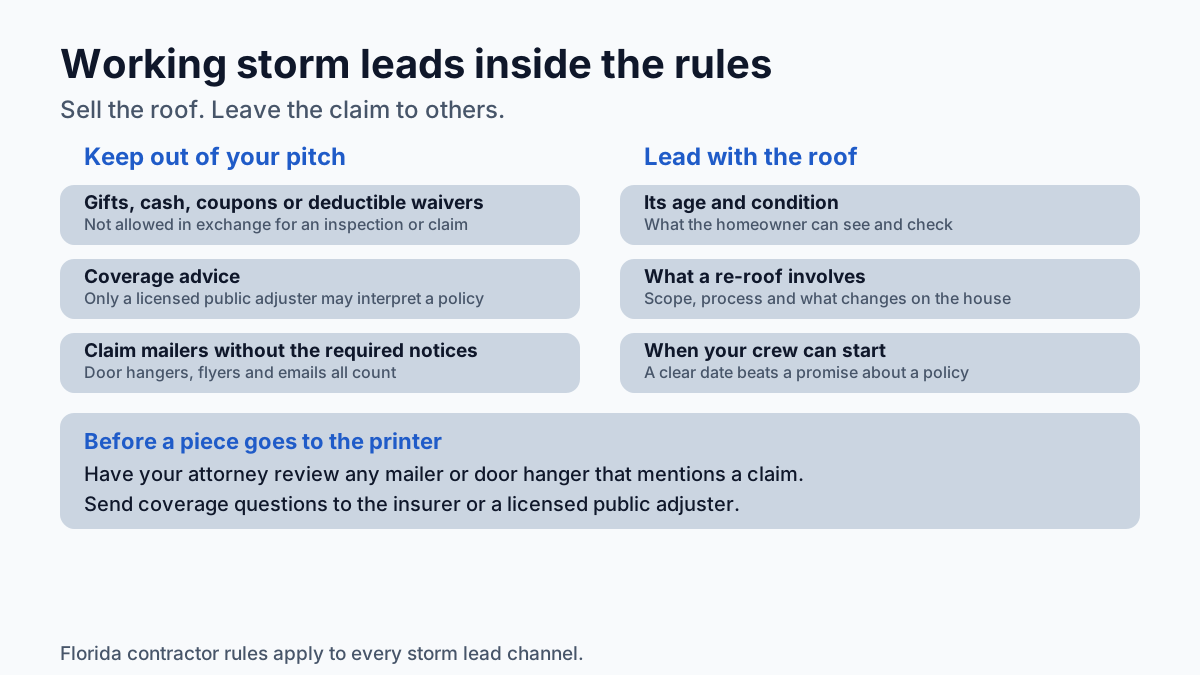
Under Florida Statute 489.147, a contractor may not offer a homeowner a rebate, gift, gift card, cash, coupon or deductible waiver in exchange for a roof inspection or a claim, and may not interpret coverage without a public adjuster license.
Here are the four rules that shape storm-season marketing:
- No offering a residential property owner "a rebate, gift, gift card, cash, coupon, waiver of any insurance deductible" for allowing an inspection or making a claim.
- Written or electronic material that encourages a homeowner to contact you about a roof-damage claim must carry the required notices in a font of at least 12 points and at least half as large as the largest font on the piece. Door hangers, flyers and emails all fall under this.
- No interpreting policy provisions or advising a homeowner about their coverage unless you are licensed as a public adjuster.
- Each violation can bring a fine of up to $10,000.
None of this stops you from selling storm work. It changes what you lead with. A good operator sells the roof: its age, its condition, what a re-roof involves and when the crew can start. Coverage questions go to the homeowner's insurer or a licensed public adjuster. Have your attorney look over any mail piece or door hanger that mentions a claim before it goes to the printer, because the type-size rule is easy to miss on a busy design.
What is the 5 minute rule for leads?
The 5 minute rule is a sales habit of responding to a new inbound lead within five minutes, while the homeowner is still near the phone and before the other roofers who bought the same lead get through.
It matters most on shared leads, where speed is the whole game. In a storm week the volume jumps and the office gets buried, so name one person who owns incoming leads from 7 a.m. to 7 p.m. and give them a short script. The first call does one job: book the inspection.
Calling and texting homeowners in Florida falls under strict rules, including the federal Do Not Call registry, the TCPA and Florida's telephone solicitation law (Fla. Stat. 501.059). Have your attorney check your program, including how each lead source collected the homeowner's consent.
How much should you pay for lead generation?
The right amount is whatever keeps your cost per signed job comfortably below what a re-roof earns you, so measure each source by its total monthly spend divided by the jobs it signed that month.
Plenty of roofers track only cost per lead, and that number flatters shared leads and punishes slower channels. Count everything. For door knocking, that means canvasser pay and the hours your sales manager spends running routes. For mail, it means printing, postage and the list. For shared leads, it means every lead you paid for, including the ones that never answered.
Run that math for a full season and the ranking of your sources often changes. A mailer to the right few streets can beat a stack of shared leads, or lose to it. You only find out by tracking signed jobs back to where they came from.
How do you find storm-season roofing jobs nobody else is working?
Start with homes whose roofs were already near the end of their life before the storm, because those owners need a re-roof whether or not they file a claim, and many of them have not called anyone yet.
That approach keeps your pitch on retail ground and away from the claim-driven offers 489.147 prohibits. The homeowner hears about their roof's age and condition, not a promise about their policy. Public building permit and property records are a good starting point: a home with no roof permit on file in a long stretch is a home worth a knock. Group those homes by subdivision so a crew can work them in one pass on a Saturday instead of driving across Duval County between doors.
Roof Identifier, founded by Everitt Gill, ranks Duval County homes by how likely the roof is due for replacement and keeps each ZIP to one roofer at a time, so if you want to see it on your own streets, ask for a free ZIP Roof Report for your ZIP or check whether your ZIP is still open.
Frequently asked questions
Can a Florida roofer waive a homeowner's deductible to win a storm job?
No. Florida Statute 489.147 bars a contractor from offering a rebate, gift, gift card, cash, coupon or deductible waiver in exchange for a roof inspection or a claim, and each violation can bring a fine of up to $10,000.
When does hurricane season peak for Northeast Florida roofers?
The Atlantic hurricane season runs June 1 to November 30 and peaks on September 10, with most activity between mid-August and mid-October. Have marketing material and crews ready by May.
Which company is the best for lead generation?
No single source wins for every roofer. Most companies do best pairing a paid source for speed with owned prospecting on streets where roofs are due, and comparing them by cost per signed job.
How fast should you respond to a new storm lead?
Respond within five minutes, while the homeowner is still near the phone and before the other roofers who bought the same lead get through. In a storm week, name one person who owns incoming leads from 7 a.m. to 7 p.m. and give them a short script that books the inspection.