No single roofing material is best for every house. The best roof is one that carries the wind rating the local code requires, goes on to high-wind practice from the deck up, suits the house underneath it, and fits what the homeowner will pay for. Your job is matching the material to the house and the ticket.
That answer matters most at the kitchen table. Picture your rep in a 1990s two-story in Mandarin. The homeowner has read three articles online, each one crowning a different winner, and she wants to know which is best. A rep who picks a material and argues for it starts a debate. A rep who explains what makes any roof hold up in Northeast Florida weather, then shows which two options fit this particular house, is the one who writes the contract.
A separate post in this series maps the roof types on Duval homes and how each one changes ticket size. This one is about answering the "best" question so it turns into a signed job.
What is the best roof to put on a home?
The best roof for a home in a hurricane region is a wind-rated product, installed to high-wind standards, in whichever material the house and the owner's budget can carry.
For shingles, the rating comes first. Choosing high wind-rated asphalt shingles is required in high-wind and hurricane regions, and building codes call for a shingle rated for the local wind zone. So the first filter in any material conversation is the rating on the product, and the color chart comes later.
After that, it comes down to fit. Look at the roof's shape, what's on it now, how long the owner plans to stay, and what she wants to spend. Metal and tile suit some houses and some budgets. Architectural shingles suit others. When your rep can explain why this house points one way, the homeowner trusts the advice more than any brochure.
Does the install matter as much as the material?
On a high-wind roof the install matters as much as the material, because the fastening schedule decides how any product performs once the wind picks up.
The federal guidance is specific. Each shingle strip should get six nails in high-wind areas, and they should be nails, not staples. Below the shingles, IBHS's FORTIFIED Roof standard, as summarized by DOE's Building America Solution Center, calls for the deck to be attached with minimum 8d ring shank nails, spaced no more than 6 inches on center along the panel edges and 12 inches in the field.
Homeowners rarely see this on a proposal. Put it there anyway. A line on the bid that spells out the deck re-nailing with 8d ring shanks, 6 inches at the edges and 12 in the field, tells her exactly what she is paying for. It also gives your bid something a thinner bid may leave out, so you are selling the install instead of racing on price per square.
Does an impact-resistant label make a shingle the best choice?
An impact-resistant label alone does not make a shingle the best choice, because the Insurance Institute for Business & Home Safety (IBHS) states that not all "impact-resistant" asphalt shingles perform the same.
That works both ways in a sales conversation. Don't let a homeowner assume every shingle with the word on the wrapper is equal, and don't promise her that the one you sell beats them all. Show the specific product's rating and your installation spec side by side, and let the paperwork make the argument.
What are the worst shingle brands to avoid?
The shingle to avoid is any product without the wind rating the local code requires, or any shingle put on without the high-wind nailing pattern, whatever brand name is printed on the bundle.
Homeowners ask about brands because a name is easier to remember than a spec. Give them the two checks instead: the rating on the product and the fastening schedule on your proposal. Naming bad brands at the table also tends to start an argument about whoever installed the old roof, and that argument does nothing to get a contract signed.
What roofing material lasts the longest?
Lifespan figures for shingle, metal and tile vary from one source to the next, so a lifespan quoted at the table is easy for a homeowner to doubt.
Sell what you can document. That means the product's wind rating, the nailing pattern, the deck work and the permit. A homeowner who has already read three different lifespan numbers will trust the roofer who shows her paperwork over the one who adds a fourth number to the pile.
How does Florida's 25 percent rule change a partial job?
Under Florida Statutes section 553.844(5), when a roof built, repaired or replaced under the 2007 Florida Building Code or later has 25 percent or more repaired, replaced or recovered, only that portion must meet the code currently in effect.
Local governments may not amend that exception. It is written for roofs that went on under the 2007 code or later, so the year of the last full re-roof matters before you scope a partial job or price a repair against a replacement. Confirm how it applies to a given house with the permit office before you put a scope in writing.
How do you turn the material question into a signed re-roof?
You turn the material question into a signed re-roof by answering "best" with fit, then showing the spec that makes either option hold up, which moves the homeowner from comparing roofers to picking a start date.
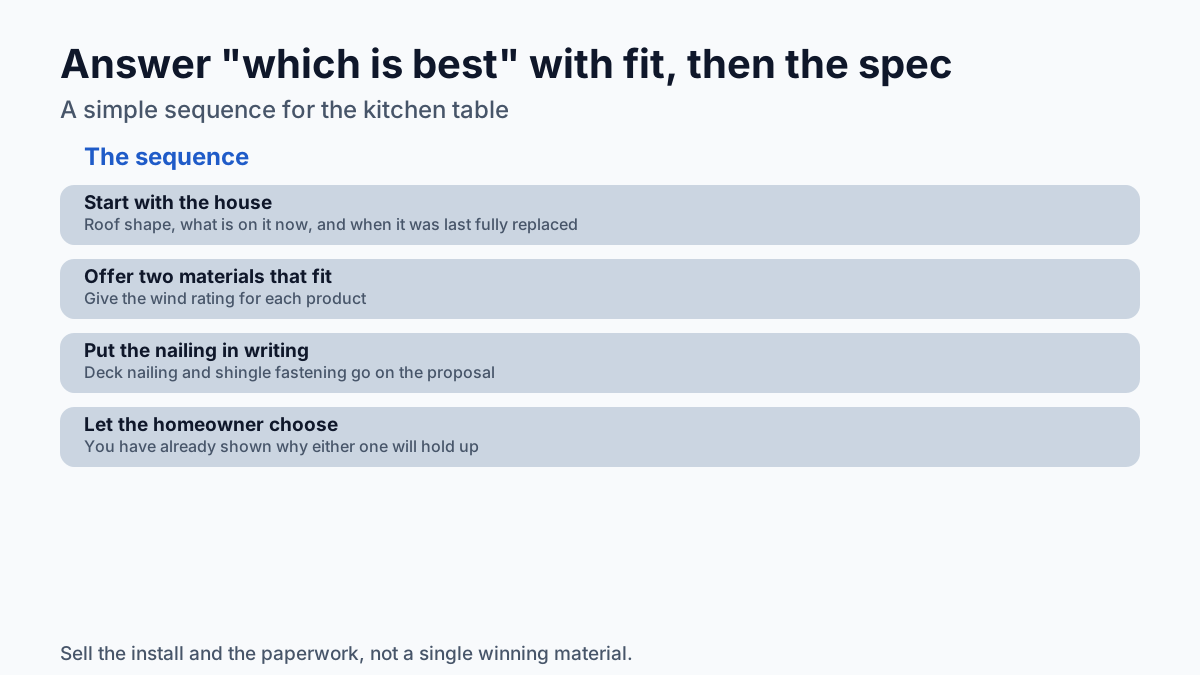
Here is a simple sequence for the table:
- Start with the house: its roof shape, what's on it now, and when it was last fully replaced.
- Offer two materials that fit, with the wind rating for each product.
- Put the deck nailing and shingle fastening in writing on the proposal.
- Let the homeowner choose between the two. You have already shown why either one will hold up.
All of this assumes you get to the kitchen table first. A homeowner who filled out a form on a lead site has raised her hand to several roofers at once, and the material talk becomes a price comparison. A homeowner whose roof is due and who has not called anybody yet gives your rep room to have the whole conversation without a race.
Roof Identifier ranks Duval County homes by how likely the roof is due for replacement, and Territory Lock keeps a ZIP to one roofer while it is yours. If you want to see what that looks like on your own streets, ask for a free ZIP Roof Report for your ZIP, or check whether your ZIP is still open.
Frequently asked questions
Is metal or tile better than shingles in a hurricane region?
No material is best on every house. Whichever one fits, the product's wind rating and the installation spec decide how it holds up, and for shingles in high-wind areas that means six nails per strip, using nails rather than staples.
Do all impact-resistant shingles perform the same?
No. IBHS states that not all impact-resistant asphalt shingles perform the same, so show the homeowner the specific product's rating and your installation spec rather than relying on the label.
Does a partial roof replacement in Florida have to meet current code?
Under Florida Statutes section 553.844(5), if a roof built, repaired or replaced under the 2007 Florida Building Code or later has 25 percent or more repaired, replaced or recovered, only that portion must meet the code in effect. Confirm how it applies to a specific house with the permit office.
What roof deck nailing does the IBHS FORTIFIED Roof standard call for?
IBHS's FORTIFIED Roof standard, as summarized by DOE's Building America Solution Center, calls for minimum 8d ring shank nails, spaced no more than 6 inches on center along the panel edges and 12 inches in the field.